Survivability and Traffic Grooming in WDM Optical Networks
Providing detailed coverage of key issues in modern optical networks, this highly useful book provides a framework for dealing with survivability and traffic grooming in wide-area networks.
 TABLE OF CONTENTS
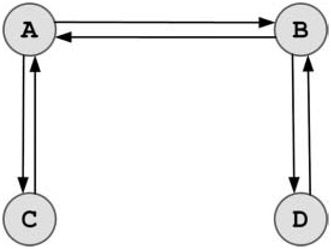
 An interconnection network connects various sources of information using a set of point-to-point links. A link is a connection using a copper wire or an optical fiber, or may be wireless. The nodes are autonomous data sources and can request to transfer any amount of information to any other node. Figure A2.1 shows an example network consisting of four nodes. Node A has a link connected to nodes B and C. Node B is connected to nodes A and D. Nodes C and D are connected to nodes A and B, respectively. If node C desires to send some information to node B, it sends it to node A which in turn routes it to node B. Node A thus acts as an intermediate node. The capacity of a node is the amount of information it can transmit (also called its source capacity) or receive (also called its sink capacity). The capacity of a link is the amount of information that can be transferred over the link in one unit of time.
The network design deals with the interconnection of various nodes and how to transmit information from one node to another. Network architecture and design both have multiple meanings. The most commonly used interpretation relates to the decisions one needs to make to design a network. The four most important aspects of network architecture and design are described here.
A topology defines how nodes are interconnected. For example,...