Survivability and Traffic Grooming in WDM Optical Networks
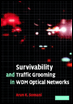
Providing detailed coverage of key issues in modern optical networks, this highly useful book provides a framework for dealing with survivability and traffic grooming in wide-area networks.
 TABLE OF CONTENTS
 Optical components are devices that transmit, shape, amplify, switch, transport, or detect light signals. The improvements in optical component technologies over the past few decades have been the key enabler in the evolution and commercialization of optical networks. In this appendix, the basic principles behind the functioning of the various components are briefly reviewed. In general, there are three groups of optical components.
Active components: devices that are electrically powered, such as lasers, wavelength shifters, and modulators.
Passive components: devices that are not electrically powered and that do not generate light of their own, such as fibers, multiplexers, demultiplexers, couplers, isolators, attenuators, and circulators.
Optical modules: devices that are a collection of active and/or passive optical elements used to perform specific tasks. This group includes transceivers, erbium-doped amplifiers, optical switches, and optical add/drop multiplexers.
The backbone that connects all of the nodes and systems together is the optical fiber. The fiber allows signals of enormous frequency range (25 THz) to be transmitted over long distances without significant distortion in the information content. While there are losses in the fiber due to reflection, refraction, scattering, dispersion, and absorption, the bandwidth available in this medium is orders of magnitude more than that provided by other conventional mediums such as copper cables. As will be explained below, the bandwidth available in the fiber is limited only by the attenuation characteristics of the medium at low frequencies and its dispersion characteristics at high frequencies.