Survivability and Traffic Grooming in WDM Optical Networks
Providing detailed coverage of key issues in modern optical networks, this highly useful book provides a framework for dealing with survivability and traffic grooming in wide-area networks.
 TABLE OF CONTENTS
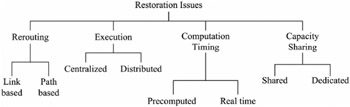
 The restoration schemes differ in their assumptions concerning the functionality of cross-connects, the traffic demand, the performance metric, and the network control. Survivability paradigms are classified based on their rerouting methodology as being path-/link-based, execution mechanisms as centralized/distributed, by their computation timing as precomputed/real time, and their capacity sharing as dedicated/shared [35, 72, 79, 82, 83, 101, 106, 107, 132, 135, 183, 184, 198, 199, 205, 210, 214, 251, 285, 288, 289, 291, 309]. This classification is shown in Fig. 3.1.
Pro-active vs. reactive restoration. A pro-active or reactive restoration method is either link-based or path-based [36, 208]. In a special case, a segment-based approach can also be used. In a segment-based detouring, a backup segment is assigned for more than one link. A link may be covered by more than one segment. The restoration path, as shown in Fig. 3.2, is computed for each path. In the case of a link failure, the backup segment is used.
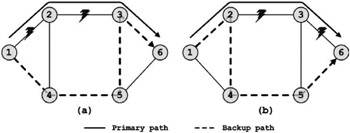
Link-based restoration methods reroute disrupted traffic around the failed link, while path-based rerouting replaces the whole path between the source and the destination of a demand. Thus, a link-based method employs local detouring while the path-based method employs end-to-end detouring. The two detouring mechanisms are shown in Fig. 3.3. For a link-based method, all routes passing through a link are transferred to a local rerouting path that replaces that link. While...