Survivability and Traffic Grooming in WDM Optical Networks
Providing detailed coverage of key issues in modern optical networks, this highly useful book provides a framework for dealing with survivability and traffic grooming in wide-area networks.
 TABLE OF CONTENTS
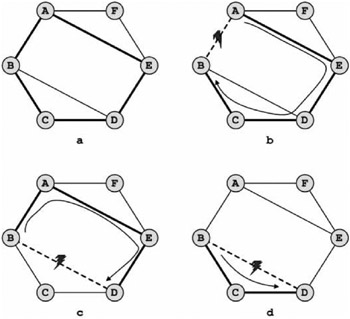
 The p-cycle (preconfigured protection cycles) is a cycle-based protection method introduced in [298, 299]. It can be characterized as embedding of multiple rings to act as protection cycles in a mesh network. The p-cycles are configured with spare network capacity to provide protection to connections. The design goal of p-cycle protection is to retain the capacity efficiency of a mesh-restorable network, while approaching the speed of a line-switched self-healing ring [298]. In p-cycle protection, when a link fails, only the end nodes of the failed link need to perform real-time switching. This makes p-cycle similar to SONET/SDH line-switched rings in terms of the speed of recovery from link failures. The key difference between p-cycle and ring protection is that p-cycle protection not only protects the links on the cycle, as is the case for ring protection, it also protects straddling links. A straddling link is an off-cycle link for which the two end nodes are both on the cycle. This important property effectively improves the capacity efficiency of p-cycles. Figure 4.1 depicts an example that illustrates p-cycle protection. In Fig. 4.1(a), A B C D E A is a p-cycle formed using reserved capacity on the links for protection. When an on-cycle link A B fails, the p-cycle can provide protection as shown in Fig. 4.1(b). When a straddling link B D fails, each p-cycle protects two working paths on the link by providing two alternate paths as shown in Figs. 4.1(c) and (d), for the entire traffic on the link in both directions.