Commercial Awareness and Business Decision Making Skills

The most common method for calculating depreciation is known as the straight-line method.
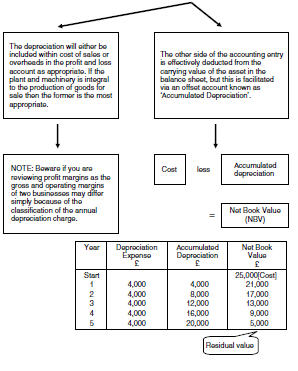
The basic accounting for this charge is shown in Example 12.1, but immediately the dangers of depreciation are clear as both the useful economic life of the asset and its residual value at the end of this period are estimates. This provides scope for manipulation by management (e.g. a doubling of the useful economic life halves the expense and increases profit, asset values and equity which will have a beneficial impact on key ratios).
It is this discretionary element to depreciation and the fact that it does not create a cash flow that leads many analysts to exclude it from the numbers. This is the origin of the term EBITDA (Earnings before interest, tax, depreciation and amortization).
ABC plc purchases new plant and machinery for 25,000 and estimates that it was to make a valuable contribution to the business for 5 years after which it can be sold for 5,000.