Commercial Awareness and Business Decision Making Skills
Chapter 21: Group Financial Statements The Basics

Problems associated with the veil of incorporation

The veil of incorporation refers to the fact that a company is a separate legal entity and hence the assets and liabilities reflected on its balance sheet are owned or owed in the name of the company and not its shareholders. The latter ultimately have the right to receive the value of the net assets upon the winding up of the business, but do not have title to the individual assets themselves.

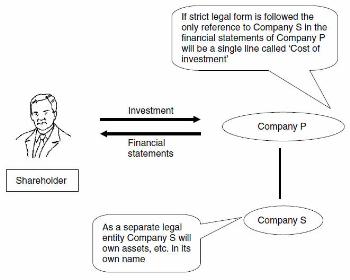
When one company invests in the shares of another such that it gains control over its financing and operating decisions this creates significant problems for the shareholders of the investor company when trying to understand the nature of the investment (Figure 21.1).


Figure 21.1: Strict adherence to the veil of incorporation

When the shareholders of Company P receive the financial statements they will know what the investment in Company S cost, but have no idea of the assets and liabilities of which it is comprised. Most would find this unacceptable given that they are the ultimate beneficiaries of Company P's net assets and yet have no idea of their...

UNLIMITED FREE
ACCESS
TO THE WORLD'S BEST IDEAS

SUBMIT
Already a GlobalSpec user? Log in.

This is embarrasing...

An error occurred while processing the form. Please try again in a few minutes.

Customize Your GlobalSpec Experience

Category: Enterprise Asset Management Software (EAM)
Finish!
Privacy Policy

This is embarrasing...

An error occurred while processing the form. Please try again in a few minutes.