Many different fields,
including medicine, optics,
physics, and electrical engineering,
use the Fourier Transform (FT) as a
common analysis tool.
In practice, the standards by compression groups
JPEG (Joint Photographic Experts Group)
and MPEG (Motion Picture Experts Group) use
a modified form of the Fourier transform.
Essentially, it allows us
to look at frequency information instead of time information,
which people find more natural for some data.
For example, many stereo systems have rows of little lights that
glow according to the strength of frequency bands.
The stronger the treble, for example, the more lights along the
row are lit, creating a light bar that rises and falls according to
the music. This is the type of information produced by the
Fourier transform.
The Discrete Fourier Transform (DFT) is the version of this transform
that we will concentrate on, since it works on discrete data.
Our data are discrete in time, and we can assume that they
are periodic. That is, if we took another N samples they
would just be a repeat of the data we already have, in terms of
the frequencies present.
In this case,
we use the DFT, which produces discrete frequency information
that we also assume is periodic.
Below, in Figure 6.1, we see the frequency magnitude
response graph for the "ee' sound. We got this by applying
the discrete Fourier transform to the sound file. The figure
shows the whole range along the top, and a close-up view on the
bottom.
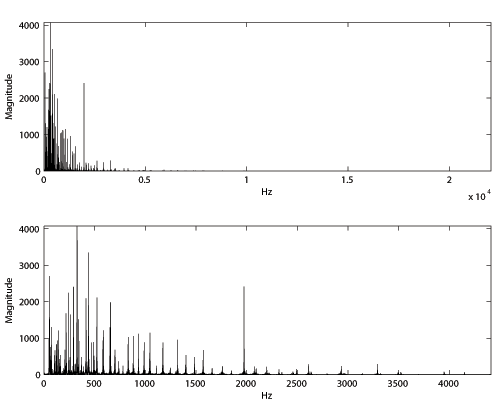
The following graph, Figure 6.2, shows
the frequency magnitude response for another sound file: a brief
recording of Adagio from Toccata and Fuge in C, written
by J.S. Bach. The top of this figure shows the entire
frequency range, from 0 to 22,050 Hz, while the bottom part
shows a close-up view of the first 4500 frequencies.
An interesting thing to notice is
that the spikes in magnitude are regularly spaced. This
happens often with real signals, especially music.
For example,
right before 1000 Hz, we see three spikes increasing in magnitude,
corresponding to three different
Figure 6.1: A person vocalizing the "ee' sound. |
(but related) frequencies.
We call this harmonics.
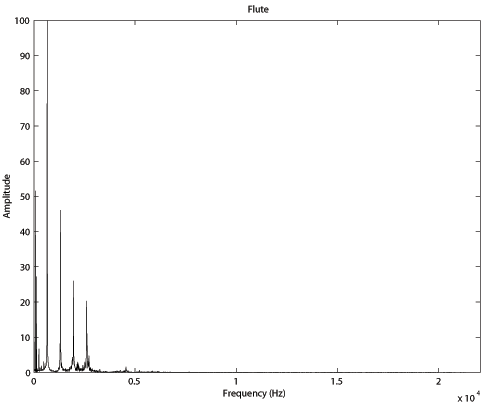
This can be seen even more clearly in Figure 6.3,
where a sustained note from a flute is played. Four frequencies
are very pronounced, while most of the other frequencies are 0.
Figure 6.2:
J.S. Bach's Adagio from Toccata and Fuge in C–frequency magnitude response. |
The frequency range appearing above (0 to 22,050 Hz) was not arbitrarily chosen.
Compact Disks (CDs) store music recorded at 44,100 samples per second, allowing
for sounds in the range of 0 to 22,050 Hz, which is slightly greater than the maximum
frequency that we can hear. It should not be surprising that almost all of the frequency
content in Bach's music shown in Figure 6.2 is below 4000 Hz.
The organ, for which this music was written, can produce a very wide range of sound.
Some organs can produce infrasound notes (below 20 Hz,
which most humans cannot hear), and also go well beyond 10 kHz.
But these high notes are not necessary for pleasing music.
To put this in perspective, consider that
most instruments (guitar, violin, harp, drums, horns, etc.)
cannot produce notes with fundamental frequencies above 4000 Hz,
though instruments do produce harmonics that appear above this frequency. A piano has a range of 27.5 Hz to just over 4186 Hz.
The Fourier transform is a way to map continuous time, nonperiodic
data to continuous frequency, nonperiodic data in the frequency-domain.
A variation called Fourier Series works with
periodic data that is continuous in time,
and turns it into a nonperiodic discrete frequency representation.
When the data are discrete in time, and nonperiodic, we can use the
discrete time Fourier transform (DTFT)
to get a periodic, continuous
frequency representation. Finally, when the data are discrete in time
(and we can assume that they are periodic), we use the DFT to get a
discrete frequency, assumed periodic representation.
Figure 6.3: A sustained note from a flute. |
© 2026 Infinity Science Press

 TABLE OF CONTENTS