Chapter 9.11 - Wavelet Transform Theory
The discrete wavelet transform convolves the input by the shifts (translation
in time) and scales (dilations or contractions) of the wavelet. Below are
variables commonly used in wavelet literature:
g represents the highpass (wavelet) filter
h represents the lowpass (scaling) filter
J is the total number of octaves
j is the current octave (used as an index.  )
)
N is the total number of inputs
n is the current input (used as an index. 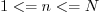 )
)
L is the width of the filter (number of taps)
k is the current wavelet coefficient
 represents the continuous wavelet transform (CWT) of function
![$W_h[j, n]$](/RefArticleImages/AC20BF92F42FAE8F4B1DC1261E2AD45F_img354_9.gif) represents the discrete wavelet transform of function
represents the discrete wavelet transform of function
![$W[j, n]$](/RefArticleImages/AC20BF92F42FAE8F4B1DC1261E2AD45F_img355_9.gif) represents the discrete scaling function of , except:
represents the discrete scaling function of , except:
![$W[0, n]$](/RefArticleImages/AC20BF92F42FAE8F4B1DC1261E2AD45F_img356_9.gif) which is the input signal.
which is the input signal.
The continuous wavelet transform is represented by:

where  is the function to analyze,
  is the wavelet,
and
is the wavelet,
and  is the shifted and scaled version of the wavelet at time
  and scale
  . An alternate form of the equation is:

again where is the wavelet,
while the wavelet family is shown above as
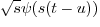 , shifted by
 and scaled by
  . We can rewrite the wavelet transform as an inner product:

This inner product is essentially computed by the filters.
So far, this background focuses
on how to get the wavelet transform given a wavelet, but how does one
get the wavelet coefficients and implement the transform with filters?
The relationship between wavelets and the filter banks that implement
the wavelet transform is as follows. The scaling function,  , is determined
through recursively applying the filter coefficients, since multiresolution
recursively convolutes the input vector after shifting and scaling. All
the information about the scaling and wavelet functions is found by the
coefficients of the scaling function and of the wavelet function, respectively.
The scaling function is given as:
, is determined
through recursively applying the filter coefficients, since multiresolution
recursively convolutes the input vector after shifting and scaling. All
the information about the scaling and wavelet functions is found by the
coefficients of the scaling function and of the wavelet function, respectively.
The scaling function is given as:
![\begin{displaymath}\phi(t) = \sqrt{2} \sum_{k} h[k] \phi(2t-k) . \end{displaymath}](/RefArticleImages/AC20BF92F42FAE8F4B1DC1261E2AD45F_img367_9.gif)
The wavelet function is
given as:
![\begin{displaymath}\psi(t) = \sqrt{2} \sum_{k} g[k] \phi(2t-k) . \end{displaymath}](/RefArticleImages/AC20BF92F42FAE8F4B1DC1261E2AD45F_img368_9.gif)
There is a finite set of coefficients ![$h[k]$](/RefArticleImages/AC20BF92F42FAE8F4B1DC1261E2AD45F_img369_9.gif) . Once these
coefficients are found, allowing us to design the lowpass filter,
then the highpass filter coefficients are easy to find.
Daubechies chose the following coefficients,
with many desirable (and required) properties,
and solved the above equations with them.
. Once these
coefficients are found, allowing us to design the lowpass filter,
then the highpass filter coefficients are easy to find.
Daubechies chose the following coefficients,
with many desirable (and required) properties,
and solved the above equations with them.
Lowpass (scaling) coefficients:
![\begin{displaymath}h[0], h[1], h[2], h[3] = \frac{1 + \sqrt{3}}{4 \sqrt{2}}, \fr...
...c{3 - \sqrt{3}}{4 \sqrt{2}}, \frac{1 - \sqrt{3}}{4 \sqrt{2}} . \end{displaymath}](/RefArticleImages/AC20BF92F42FAE8F4B1DC1261E2AD45F_img370_9.gif)
These produce a space,  , that has invariance to shift and scale, which
is needed for multiresolution analysis. Now that we have coefficients
for the lowpass filter, the corresponding highpass (wavelet)
filter coefficients can be calculated, as follows:
, that has invariance to shift and scale, which
is needed for multiresolution analysis. Now that we have coefficients
for the lowpass filter, the corresponding highpass (wavelet)
filter coefficients can be calculated, as follows:
![\begin{displaymath}g[0], g[1], g[2], g[3] = \frac{1 - \sqrt{3}}{4 \sqrt{2}}, \fr...
...{3 + \sqrt{3}}{4 \sqrt{2}}, \frac{-1 - \sqrt{3}}{4 \sqrt{2}} . \end{displaymath}](/RefArticleImages/AC20BF92F42FAE8F4B1DC1261E2AD45F_img372_9.gif)
Notice that ![$g[0]=h[3]$](/RefArticleImages/AC20BF92F42FAE8F4B1DC1261E2AD45F_img373_9.gif) ,
, ![$g[1]=-h[2]$](/RefArticleImages/AC20BF92F42FAE8F4B1DC1261E2AD45F_img374_9.gif) ,
, ![$g[2]=h[1]$](/RefArticleImages/AC20BF92F42FAE8F4B1DC1261E2AD45F_img375_9.gif) , and
, and ![$g[3]=-h[0]$](/RefArticleImages/AC20BF92F42FAE8F4B1DC1261E2AD45F_img376_9.gif) .
.
This pattern appears in the filter bank shown in Figure 9.4.
The significance
of the above coefficients is that they are used in a filter bank to generate
the wavelet transform.
Writing the wavelet equation with regard to the discretely sampled sequence
![$x[n]$](/RefArticleImages/AC20BF92F42FAE8F4B1DC1261E2AD45F_img6_9.gif) :
:
![\begin{displaymath}W_f[a,b] = \frac{1}{\sqrt{a}} \sum_{n=b}^{aL+b-1} x[n] g\left(\frac{n - b}{a}\right) \end{displaymath}](/RefArticleImages/AC20BF92F42FAE8F4B1DC1261E2AD45F_img377_9.gif)
where the wavelet is replaced by function  , which
is obtained by sampling the continuous wavelet function. For the discrete
case, we let
, which
is obtained by sampling the continuous wavelet function. For the discrete
case, we let  and require that the parameters (
 ) as well as
  be integers. To make this clearer, we replace and (which represent
real numbers above) with
be integers. To make this clearer, we replace and (which represent
real numbers above) with  and
and  (which represent whole numbers). With
the discrete case, redundancy is not required in the transformed signal.
To reduce redundancy, the wavelet equation must satisfy certain conditions.
First, we must introduce an orthogonal scaling function, which allows
us to have an approximation at the last level of resolution (the initial
level of resolution is simply the input signal).
As we saw in previous sections, the coefficients for the scaling filter
(lowpass) and the wavelet filter (highpass) are intimately related.
The functions that produce these coefficients are also dependent on
one another.
Second, the representation
of the signal at octave must have all the information of the signal
at octave
(which represent whole numbers). With
the discrete case, redundancy is not required in the transformed signal.
To reduce redundancy, the wavelet equation must satisfy certain conditions.
First, we must introduce an orthogonal scaling function, which allows
us to have an approximation at the last level of resolution (the initial
level of resolution is simply the input signal).
As we saw in previous sections, the coefficients for the scaling filter
(lowpass) and the wavelet filter (highpass) are intimately related.
The functions that produce these coefficients are also dependent on
one another.
Second, the representation
of the signal at octave must have all the information of the signal
at octave  , which makes sense: the input signal has more information
than the first approximation of this signal. The function is thus
changed to
, which makes sense: the input signal has more information
than the first approximation of this signal. The function is thus
changed to ![$W[j-1,m]$](/RefArticleImages/AC20BF92F42FAE8F4B1DC1261E2AD45F_img383_9.gif) , which is the scaling function's decomposition from
the previous level of resolution, with
, which is the scaling function's decomposition from
the previous level of resolution, with  as an index.
Third, after
as an index.
Third, after  levels of resolution,
the result of the scaling function on the signal will be 0. After repeatedly
viewing a signal at coarser and coarser approximations, eventually the
scaling function will not produce any useful information. Fourth, the
scaling function allows us to approximate any given signal with a variable
amount of precision. The scaling function,
levels of resolution,
the result of the scaling function on the signal will be 0. After repeatedly
viewing a signal at coarser and coarser approximations, eventually the
scaling function will not produce any useful information. Fourth, the
scaling function allows us to approximate any given signal with a variable
amount of precision. The scaling function,  , gives us an
approximation
of the signal via the following equation. This is also known as the lowpass
output:
, gives us an
approximation
of the signal via the following equation. This is also known as the lowpass
output:
![\begin{displaymath}W[j,n] = \sum_{m=0}^{N-1} W[j-1,m] h[2n-m] . \end{displaymath}](/RefArticleImages/AC20BF92F42FAE8F4B1DC1261E2AD45F_img387_9.gif)
The wavelet function gives us the detail signal, also
called highpass output:
![\begin{displaymath}W_{h}[j,n] = \sum_{m=0}^{N-1} W[j-1,m] g[2n-m] . \end{displaymath}](/RefArticleImages/AC20BF92F42FAE8F4B1DC1261E2AD45F_img388_9.gif)
The term gives us the shift, the starting points for the wavelet
calculations. The index  incorporates the scaling,
resulting in half the outputs for octave compared to
the previous octave
incorporates the scaling,
resulting in half the outputs for octave compared to
the previous octave  .
.
Example:
Suppose
 , and
, and
 . Find the detail signal
produced by the wavelet transform on this signal.
. Find the detail signal
produced by the wavelet transform on this signal.
Answer:
![\begin{displaymath}W[0, n] = x[n] \end{displaymath}](/RefArticleImages/AC20BF92F42FAE8F4B1DC1261E2AD45F_img393_9.gif)
![\begin{displaymath}W_h[1, n] = W[0, 0] g[2n-0] + W[0, 1] g[2n-1] + W[0, 2] g[2n-2] + W[0, 3] g[2n-3] \end{displaymath}](/RefArticleImages/AC20BF92F42FAE8F4B1DC1261E2AD45F_img394_9.gif)
![\begin{displaymath}+ W[0, 4] g[2n-4] + W[0, 5] g[2n-5] + W[0, 6] g[2n-6] + W[0, 7] g[2n-7] \end{displaymath}](/RefArticleImages/AC20BF92F42FAE8F4B1DC1261E2AD45F_img395_9.gif)
For this example, the value of with any index value outside of [0, 1]
is zero.
Also, the value of ![$W[j, n] = 0$](/RefArticleImages/AC20BF92F42FAE8F4B1DC1261E2AD45F_img396_9.gif) for any value of less than 0 or
greater or equal to
for any value of less than 0 or
greater or equal to  .
So we can find the individual values for
.
So we can find the individual values for  as follows.
Looking at octave 1:
![\begin{displaymath}W_h[1, n] = 34 g[2n-0] + 28 g[2n-1] + 76 g[2n-2] + 51 g[2n-3] + 19 g[2n-4] \end{displaymath}](/RefArticleImages/AC20BF92F42FAE8F4B1DC1261E2AD45F_img399_9.gif)
![\begin{displaymath}+ 12 g[2n-5] + 25 g[2n-6] + 43 g[2n-7] \end{displaymath}](/RefArticleImages/AC20BF92F42FAE8F4B1DC1261E2AD45F_img400_9.gif)
![\begin{displaymath}W_h[1, 0] = 34 g[0] + 28 g[-1] + 76 g[-2] + 51 g[-3] + 19 g[-4] + 12 g[-5] + 25 g[-6] + 43 g[-7] \end{displaymath}](/RefArticleImages/AC20BF92F42FAE8F4B1DC1261E2AD45F_img401_9.gif)
![\begin{displaymath}W_h[1, 0] = 34 \frac{1}{\sqrt{2}} \end{displaymath}](/RefArticleImages/AC20BF92F42FAE8F4B1DC1261E2AD45F_img402_9.gif)
![\begin{displaymath}W_h[1, 1] = 34 g[2] + 28 g[1] + 76 g[0] + 51 g[-1] + 19 g[-2] + 12 g[-3] + 25 g[-4] + 43 g[-5] \end{displaymath}](/RefArticleImages/AC20BF92F42FAE8F4B1DC1261E2AD45F_img403_9.gif)
![\begin{displaymath}W_h[1, 1] = 28 \frac{-1}{\sqrt{2}} + 76 \frac{1}{\sqrt{2}} \end{displaymath}](/RefArticleImages/AC20BF92F42FAE8F4B1DC1261E2AD45F_img404_9.gif)
![\begin{displaymath}W_h[1, 2] = 34 g[4] + 28 g[3] + 76 g[2] + 51 g[1] + 19 g[0] + 12 g[-1] + 25 g[-2] + 43 g[-3] \end{displaymath}](/RefArticleImages/AC20BF92F42FAE8F4B1DC1261E2AD45F_img405_9.gif)
![\begin{displaymath}W_h[1, 2] = 51 \frac{-1}{\sqrt{2}} + 19 \frac{1}{\sqrt{2}} \end{displaymath}](/RefArticleImages/AC20BF92F42FAE8F4B1DC1261E2AD45F_img406_9.gif)
![\begin{displaymath}W_h[1, 3] = 34 g[6] + 28 g[5] + 76 g[4] + 51 g[3] + 19 g[2] + 12 g[1] + 25 g[0] + 43 g[-1] \end{displaymath}](/RefArticleImages/AC20BF92F42FAE8F4B1DC1261E2AD45F_img407_9.gif)
![\begin{displaymath}W_h[1, 3] = 12 \frac{-1}{\sqrt{2}} + 25 \frac{1}{\sqrt{2}} \end{displaymath}](/RefArticleImages/AC20BF92F42FAE8F4B1DC1261E2AD45F_img408_9.gif)
![\begin{displaymath}W_h[1, 4] = 34 g[8] + 28 g[7] + 76 g[6] + 51 g[5] + 19 g[4] + 12 g[3] + 25 g[2] + 43 g[1] \end{displaymath}](/RefArticleImages/AC20BF92F42FAE8F4B1DC1261E2AD45F_img409_9.gif)
![\begin{displaymath}W_h[1, 4] = 43 \frac{-1}{\sqrt{2}} \end{displaymath}](/RefArticleImages/AC20BF92F42FAE8F4B1DC1261E2AD45F_img410_9.gif)
![\begin{displaymath}W_h[1, 5] = 34 g[10] + 28 g[9] + 76 g[8] + 51 g[7] + 19 g[6] + 12 g[5] + 25 g[4] + 43 g[3] \end{displaymath}](/RefArticleImages/AC20BF92F42FAE8F4B1DC1261E2AD45F_img411_9.gif)
![\begin{displaymath}W_h[1, 5] = 0 . \end{displaymath}](/RefArticleImages/AC20BF92F42FAE8F4B1DC1261E2AD45F_img412_9.gif)
It should be obvious that any value ![$W_h[1, n] = 0$](/RefArticleImages/AC20BF92F42FAE8F4B1DC1261E2AD45F_img413_9.gif) when
when  .
Comparing this to the filter bank approach, we look at
Figure 9.25, which shows a channel from a filter bank.
Keeping in mind
that
.
Comparing this to the filter bank approach, we look at
Figure 9.25, which shows a channel from a filter bank.
Keeping in mind
that ![$g[0] = a$](/RefArticleImages/AC20BF92F42FAE8F4B1DC1261E2AD45F_img415_9.gif) , and
, and ![$g[1] = b$](/RefArticleImages/AC20BF92F42FAE8F4B1DC1261E2AD45F_img416_9.gif) , we can trace the signal through as follows.
, we can trace the signal through as follows.

The output is a down-sampled version of  , so when we eliminate every
other value, we get:
, so when we eliminate every
other value, we get:

We end up with the same result, as expected.
Of course, the scaling equation is the same basic equation, with
different coefficients.
Figure 9.25:
One channel of the analysis side of a filter bank. |
Before we can look at octave 2,
we need to know the ![$W[1, n]$](/RefArticleImages/AC20BF92F42FAE8F4B1DC1261E2AD45F_img419_9.gif) values, which we present as the
following. Realize that these can be found in the same fashion as above,
except that both filter coefficients are positive.
values, which we present as the
following. Realize that these can be found in the same fashion as above,
except that both filter coefficients are positive.
![\begin{displaymath}W[1, 0] = \frac{34}{\sqrt{2}} \end{displaymath}](/RefArticleImages/AC20BF92F42FAE8F4B1DC1261E2AD45F_img420_9.gif)
![\begin{displaymath}W[1, 1] = \frac{28 + 76}{\sqrt{2}} = \frac{104}{\sqrt{2}}\end{displaymath}](/RefArticleImages/AC20BF92F42FAE8F4B1DC1261E2AD45F_img421_9.gif)
![\begin{displaymath}W[1, 2] = \frac{51 + 19}{\sqrt{2}} = \frac{70}{\sqrt{2}}\end{displaymath}](/RefArticleImages/AC20BF92F42FAE8F4B1DC1261E2AD45F_img422_9.gif)
![\begin{displaymath}W[1, 3] = \frac{12 + 25}{\sqrt{2}} = \frac{37}{\sqrt{2}}\end{displaymath}](/RefArticleImages/AC20BF92F42FAE8F4B1DC1261E2AD45F_img423_9.gif)
![\begin{displaymath}W[1, 4] = \frac{43}{\sqrt{2}} \end{displaymath}](/RefArticleImages/AC20BF92F42FAE8F4B1DC1261E2AD45F_img424_9.gif)
Looking at octave 2:
![\begin{displaymath}W_h[2, n] = W[1, 0] g[2n-0] + W[1, 1] g[2n-1] + W[1, 2] g[2n-2] + W[1, 3] g[2n-3] \end{displaymath}](/RefArticleImages/AC20BF92F42FAE8F4B1DC1261E2AD45F_img425_9.gif)
![\begin{displaymath}+ W[1, 4] g[2n-4] + W[1, 5] g[2n-5] + W[1, 6] g[2n-6] + W[1, 7] g[2n-7] \end{displaymath}](/RefArticleImages/AC20BF92F42FAE8F4B1DC1261E2AD45F_img426_9.gif)
![\begin{displaymath}W_h[2, n] = \frac{34}{\sqrt{2}} g[2n-0] + \frac{104}{\sqrt{2}...
...1] + \frac{70}{\sqrt{2}} g[2n-2] + \frac{37}{\sqrt{2}} g[2n-3] \end{displaymath}](/RefArticleImages/AC20BF92F42FAE8F4B1DC1261E2AD45F_img427_9.gif)
![\begin{displaymath}+ \frac{43}{\sqrt{2}} g[2n-4] + 0 g[2n-5] + 0 g[2n-6] + 0 g[2n-7] \end{displaymath}](/RefArticleImages/AC20BF92F42FAE8F4B1DC1261E2AD45F_img428_9.gif)
![\begin{displaymath}W_h[2, 0] = \frac{34}{\sqrt{2}} g[0] + \frac{104}{\sqrt{2}} g[-1] + \frac{70}{\sqrt{2}} g[-2] + \frac{37}{\sqrt{2}} g[-3] \end{displaymath}](/RefArticleImages/AC20BF92F42FAE8F4B1DC1261E2AD45F_img429_9.gif)
![\begin{displaymath}+ \frac{43}{\sqrt{2}} g[-4] + 0 g[-5] + 0 g[-6] + 0 g[-7] \end{displaymath}](/RefArticleImages/AC20BF92F42FAE8F4B1DC1261E2AD45F_img430_9.gif)
![\begin{displaymath}W_h[2, 0] = \left( \frac{34}{\sqrt{2}} \right) \left( \frac{1}{\sqrt{2}}\right) \end{displaymath}](/RefArticleImages/AC20BF92F42FAE8F4B1DC1261E2AD45F_img431_9.gif)
![\begin{displaymath}W_h[2, 0] = \frac{34}{2} = 17 \end{displaymath}](/RefArticleImages/AC20BF92F42FAE8F4B1DC1261E2AD45F_img432_9.gif)
![\begin{displaymath}W_h[2, 1] = \frac{34}{\sqrt{2}} g[2] + \frac{104}{\sqrt{2}} g[1] + \frac{70}{\sqrt{2}} g[0] + \frac{37}{\sqrt{2}} g[-1] \end{displaymath}](/RefArticleImages/AC20BF92F42FAE8F4B1DC1261E2AD45F_img433_9.gif)
![\begin{displaymath}+ \frac{43}{\sqrt{2}} g[-2] + 0 g[-3] + 0 g[-4] + 0 g[-5] \end{displaymath}](/RefArticleImages/AC20BF92F42FAE8F4B1DC1261E2AD45F_img434_9.gif)
![\begin{displaymath}W_h[2, 1] = \left( \frac{104}{\sqrt{2}} \right) \left( \frac{...
... \frac{70}{\sqrt{2}} \right) \left( \frac{1}{\sqrt{2}} \right) \end{displaymath}](/RefArticleImages/AC20BF92F42FAE8F4B1DC1261E2AD45F_img435_9.gif)
![\begin{displaymath}W_h[2, 1] = \frac{70 - 104}{2} = \frac{-34}{2} = -17 \end{displaymath}](/RefArticleImages/AC20BF92F42FAE8F4B1DC1261E2AD45F_img436_9.gif)
![\begin{displaymath}W_h[2, 2] = \frac{34}{\sqrt{2}} g[4] + \frac{104}{\sqrt{2}} g[3] + \frac{70}{\sqrt{2}} g[2] + \frac{37}{\sqrt{2}} g[1] \end{displaymath}](/RefArticleImages/AC20BF92F42FAE8F4B1DC1261E2AD45F_img437_9.gif)
![\begin{displaymath}+ \frac{43}{\sqrt{2}} g[0] + 0 g[-1] + 0 g[-2] + 0 g[-3] \end{displaymath}](/RefArticleImages/AC20BF92F42FAE8F4B1DC1261E2AD45F_img438_9.gif)
![\begin{displaymath}W_h[2, 2] = \left( \frac{37}{\sqrt{2}} \right) \left( \frac{-...
... \frac{43}{\sqrt{2}} \right) \left( \frac{1}{\sqrt{2}} \right) \end{displaymath}](/RefArticleImages/AC20BF92F42FAE8F4B1DC1261E2AD45F_img439_9.gif)
![\begin{displaymath}W_h[2, 2] = \frac{43 - 37}{2} = \frac{6}{2} = 3 \end{displaymath}](/RefArticleImages/AC20BF92F42FAE8F4B1DC1261E2AD45F_img440_9.gif)
![\begin{displaymath}W_h[2, 3] = \frac{34}{\sqrt{2}} g[6] + \frac{104}{\sqrt{2}} g[5] + \frac{70}{\sqrt{2}} g[4] + \frac{37}{\sqrt{2}} g[3] \end{displaymath}](/RefArticleImages/AC20BF92F42FAE8F4B1DC1261E2AD45F_img441_9.gif)
![\begin{displaymath}+ \frac{43}{\sqrt{2}} g[2] + 0 g[1] + 0 g[0] + 0 g[-1] \end{displaymath}](/RefArticleImages/AC20BF92F42FAE8F4B1DC1261E2AD45F_img442_9.gif)
![\begin{displaymath}W_h[2, 3] = 0 . \end{displaymath}](/RefArticleImages/AC20BF92F42FAE8F4B1DC1261E2AD45F_img443_9.gif)
Again, we can verify this with the filter bank approach.
Notice how the ![$g[2n-m]$](/RefArticleImages/AC20BF92F42FAE8F4B1DC1261E2AD45F_img444_9.gif) term takes care of down-sampling for us.
We can continue on, with the third octave.
First, we need the lowpass outputs of octave 2, found in the same way
as above, only with different coefficients.
term takes care of down-sampling for us.
We can continue on, with the third octave.
First, we need the lowpass outputs of octave 2, found in the same way
as above, only with different coefficients.
![\begin{displaymath}W[2, 0] = \frac{34}{2} = 17 \end{displaymath}](/RefArticleImages/AC20BF92F42FAE8F4B1DC1261E2AD45F_img445_9.gif)
![\begin{displaymath}W[2, 1] = \frac{174}{2} = 87 \end{displaymath}](/RefArticleImages/AC20BF92F42FAE8F4B1DC1261E2AD45F_img446_9.gif)
![\begin{displaymath}W[2, 2] = \frac{80}{2} = 40 \end{displaymath}](/RefArticleImages/AC20BF92F42FAE8F4B1DC1261E2AD45F_img447_9.gif)
![\begin{displaymath}W[2, 3] = 0 \end{displaymath}](/RefArticleImages/AC20BF92F42FAE8F4B1DC1261E2AD45F_img448_9.gif)
Looking at octave 3:
![\begin{displaymath}W_h[3, n] = W[2, 0] g[2n-0] + W[2, 1] g[2n-1] + W[2, 2] g[2n-2] + W[2, 3] g[2n-3] \end{displaymath}](/RefArticleImages/AC20BF92F42FAE8F4B1DC1261E2AD45F_img449_9.gif)
![\begin{displaymath}+ W[2, 4] g[2n-4] + W[2, 5] g[2n-5] + W[2, 6] g[2n-6] + W[2, 7] g[2n-7] \end{displaymath}](/RefArticleImages/AC20BF92F42FAE8F4B1DC1261E2AD45F_img450_9.gif)
![\begin{displaymath}W_h[3, n] = 17 g[2n-0] + 87 g[2n-1] + 40 g[2n-2] \end{displaymath}](/RefArticleImages/AC20BF92F42FAE8F4B1DC1261E2AD45F_img451_9.gif)
![\begin{displaymath}W_h[3, 0] = 17 g[0] + 87 g[-1] + 40 g[-2] = \frac{17}{\sqrt{2}} \end{displaymath}](/RefArticleImages/AC20BF92F42FAE8F4B1DC1261E2AD45F_img452_9.gif)
![\begin{displaymath}W_h[3, 1] = 17 g[2] + 87 g[1] + 40 g[0] = \frac{40 - 87}{\sqrt{2}} = \frac{-47}{\sqrt{2}} \end{displaymath}](/RefArticleImages/AC20BF92F42FAE8F4B1DC1261E2AD45F_img453_9.gif)
![\begin{displaymath}W_h[3, 2] = 17 g[4] + 87 g[3] + 40 g[2] = 0 . \end{displaymath}](/RefArticleImages/AC20BF92F42FAE8F4B1DC1261E2AD45F_img454_9.gif)
Finding the lowpass outputs for this octave:
![\begin{displaymath}W[3, 0] = 17 h[0] + 87 h[-1] + 40 h[-2] = \frac{17}{\sqrt{2}} \end{displaymath}](/RefArticleImages/AC20BF92F42FAE8F4B1DC1261E2AD45F_img455_9.gif)
![\begin{displaymath}W[3, 1] = 17 h[2] + 87 h[1] + 40 h[0] = \frac{40 - 87}{\sqrt{2}} = \frac{-47}{\sqrt{2}} \end{displaymath}](/RefArticleImages/AC20BF92F42FAE8F4B1DC1261E2AD45F_img456_9.gif)
![\begin{displaymath}W[3, 2] = 17 h[4] + 87 h[3] + 40 h[2] = 0 . \end{displaymath}](/RefArticleImages/AC20BF92F42FAE8F4B1DC1261E2AD45F_img457_9.gif)
We stop here, because we get no more useful information after this point.
Why? Because our original signal has only 8 samples, and each octave
uses only half the data of the previous octave.
In other words, since we have  values,
we should not perform more than 3 octaves of resolution on the signal.
values,
we should not perform more than 3 octaves of resolution on the signal.
We end this chapter with a program to show the frequency magnitude
response of a given wavelet.
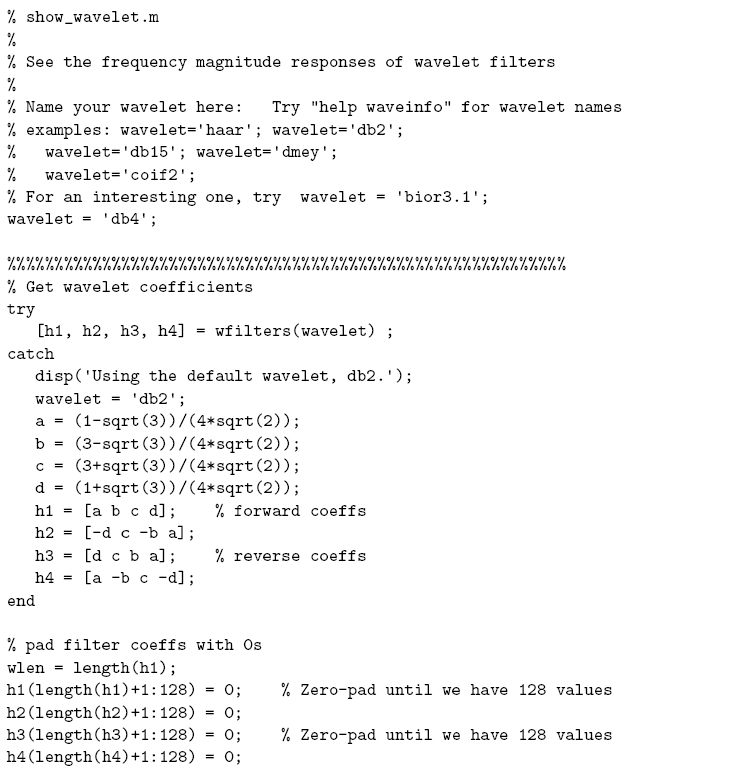
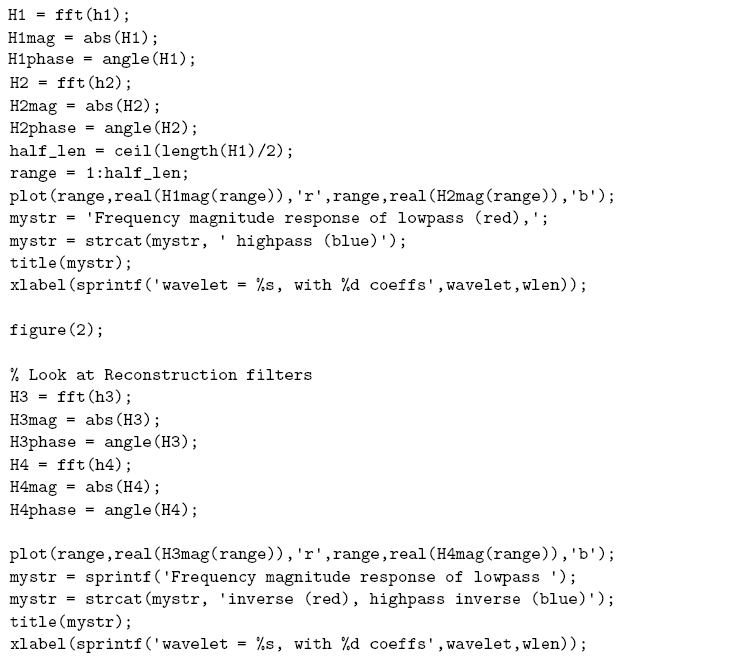
Using the default db2 wavelet, we get the graphs shown in
Figure 9.26 and Figure 9.27.
In order to see the frequency magnitude responses of other wavelets,
the wavelets toolbox must be installed. These figures show what we should
expect: the lowpass filter (and inverse lowpass filter) keep low
frequencies about the same, but attenuate high frequencies.
Figure 9.26: The first graph of the "show_wavelet' program. |
Figure 9.27: The second graph of the "show_wavelet' program.
. |
© 2026 Infinity Science Press

 TABLE OF CONTENTS