 | This text/reference provides students and practicing engineers with an introduction to the classical methods of designing electrical circuits, but incorporates modern logic design techniques used in the latest microprocessors, microcontrollers, microcomputers, and various LSI components. The book provides a review of the classical methods e.g., the basic concepts of Boolean algebra, combinational logic and sequential logic procedures, before engaging in the practical design approach and the use of computer-aided tools. The book is enriched with numerous examples (and their solutions), over 500 illustrations, and includes a CD-ROM with simulations, additional figures, and third party software to illustrate the concepts discussed in the book. |
 TABLE OF CONTENTS
 Digital Principles & Logic Design
Chapter 7 - Sequential Logic Circuits
So far, all of the logic circuits we have studied were basically based on the analysis and design of combinational digital circuits. Though these type of circuits are very important, they constitute only a part of digital systems. The other major aspect of a digital system is the analysis and design of sequential digital circuits. However, sequential circuit design depends, greatly, on the combinational circuit design.
The logic circuits whose outputs at any instant of time depend only on the input signals present at that time are known as combinational circuits. The output in combinational circuits does not depend upon any past inputs or outputs. Moreover, in a combinational circuit, the output appears immediately for a change in input, except for the propagation delay through circuit gates.
On the other hand, the logic circuits whose outputs at any instant of time depend on the present inputs as well as on the past outputs are called sequential circuits. In sequential circuits, the output signals are fed back to the input side. A block diagram of a sequential circuit is shown in Figure 7.1
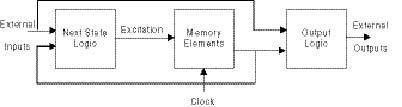
Figure 7.1 Block diagram of a sequential circuit.
From Figure 7.1, we find that it consists of combinational circuits, which accept digital signals from external inputs and from outputs of memory elements and generates signals for external outputs and for inputs to memory elements, referred to as excitation.
A memory element is a medium in which one bit of information (0 or 1) can be stored or retained until necessary, and thereafter its contents can be replaced by a new value. The contents of memory elements can be changed by the outputs of combinational circuits that are connected to its input.
Combinational circuits are often faster than sequential circuits since the combinational circuits do not require memory elements whereas the sequential circuit needs memory elements to perform its operations in sequence.
Sequential circuits are broadly classified into two main categories, known as synchronous or clocked and asynchronous or unclocked sequential circuits, depending on the timing of their signals.
A sequential circuit whose behavior can be defined from the knowledge of its signal at discrete instants of time is referred to as a synchronous sequential circuit. In these systems, the memory elements are affected only at discrete instants of time. The synchronization is achieved by a timing device known as a system clock, which generates a periodic train of clock pulses as shown in Figure 7.2. The outputs are affected only with the application of a clock pulse. The rate at which the master clock generates pulses must be slow enough to permit the slowest circuit to respond. This limits the speed of all circuits. Synchronous circuits have gained considerable domination and wide popularity.
A sequential circuit whose behavior depends upon the sequence in which the input signals change is referred to as an asynchronous sequential circuit. The output will be affected whenever the input changes. The commonly used memory elements in these circuits are time-delay devices. There is no need to wait for a clock pulse. Therefore, in general, asynchronous circuits are faster than synchronous sequential circuits. However, in an asynchronous circuit, events are allowed to occur without any synchronization. And in such a case, the system becomes unstable. Since the designs of asynchronous circuits are more tedious and difficult, their uses are rather limited. The memory elements used in sequential circuits are flip-flops which are capable of storing binary information.
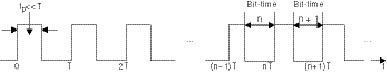
Figure 7.2 Train of pulses.
© 2006-2026 Infinity Science Press. All rights reserved.