 | This text/reference provides students and practicing engineers with an introduction to the classical methods of designing electrical circuits, but incorporates modern logic design techniques used in the latest microprocessors, microcontrollers, microcomputers, and various LSI components. The book provides a review of the classical methods e.g., the basic concepts of Boolean algebra, combinational logic and sequential logic procedures, before engaging in the practical design approach and the use of computer-aided tools. The book is enriched with numerous examples (and their solutions), over 500 illustrations, and includes a CD-ROM with simulations, additional figures, and third party software to illustrate the concepts discussed in the book. |
 TABLE OF CONTENTS
 Digital Principles & Logic Design
Chapter 8 - Registers
A register is a group of binary storage cells capable of holding binary information. A group of flip-flops constitutes a register, since each flip-flop can work as a binary cell. An
n-bit register, has n flip-flops and is capable of holding n-bits of information. In addition to flip-flops a register can have a combinational part that performs data-processing tasks.
Various types of registers are available in MSI circuits. The simplest possible register is one that contains no external gates, and is constructed of only flip-flops. Figure 8.1 shows such a type of register constructed of four S-R flip-flops, with a common clock pulse input. The clock pulse enables all the flip-flops at the same instant so that the information available at the four inputs can be transferred into the 4-bit register. All the flip-flops in a register should respond to the clock pulse transition. Hence they should be either of the edge-triggered type or the master-slave type. A group of flip-flops sensitive to the pulse duration is commonly called a gated latch. Latches are suitable to temporarily store binary information that is to be transferred to an external destination. They should not be used in the design of sequential circuits that have feedback connections.
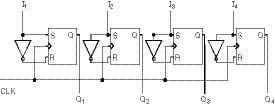
Figure 8.1 4-bit register
© 2006-2026 Infinity Science Press. All rights reserved.