Network Analysis & Circuits

A signal is a physical quantity, or quality, which conveys information. Electrical engineers normally consider a signal to be an electric current or voltage, and these currents and voltages are functions of time. The step, ramp, impulse, exponential, and sinusoidal functions, etc., are the basic signals. These signals may be combined by addition or subtraction to build a variety of general waveforms used in practice.
Signals play an important role in life. They are used in communication, speech processing, medical science, etc.
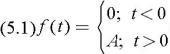
Suppose that a constant voltage or a current is suddenly applied on a circuit at time t = 0. The switching process can be described mathematically by defining a function called the step function. The step function is denoted U( t) and defined by the equations
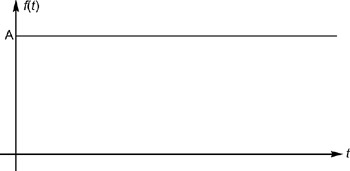
A graph of the step function is shown in the figure. For a unit step function
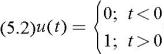
Now
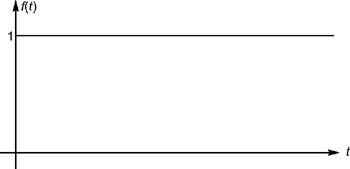
and the graph of a unit step function is
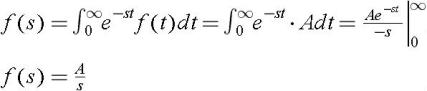
The Laplace transform of a step function is
Now the Laplace transform of a unit step function is
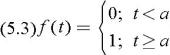
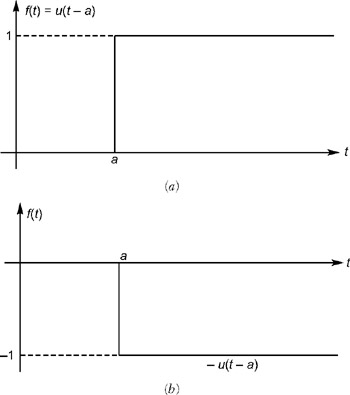
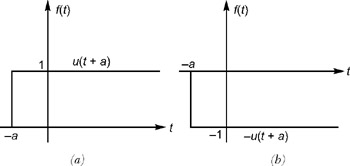
A shifted or delayed unit step function is shown in Figure 5.3(a).
The Laplace transform of a shifted unit step function is
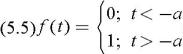
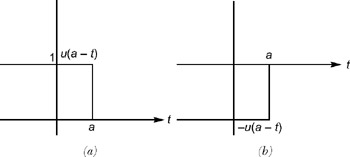
and in reversed direction.
Show how a unit pulse of width a can be obtained from two unit step functions.
Solution: It is clear by the Figure 5.2 and...