Network Analysis & Circuits

Generally speaking, network analysis is any structured technique used to mathematically analyze a circuit (a "network" of interconnected components). This chapter presents a few techniques useful in analyzing such complex circuits.
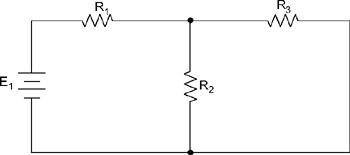
To analyze the above circuit, we would first find the equivalent of R 2 and R 3 in parallel, then add R 1 in series to arrive at a total resistance. Then, taking the voltage of battery E 1 with the total circuit resistance, the total current could be calculated through the use of Ohm's law (I = E/R), then that current figure is used to calculate voltage drops in the circuit. All in all, a fairly simple procedure.
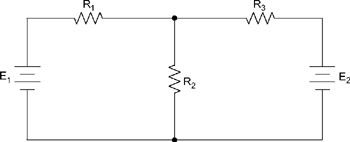
However, the addition of just one more battery could change all of that:
Resistors R 2 and R 3 are no longer in parallel with each other, because E 2 has been inserted into R 3's branch of the circuit. Upon closer inspection, it appears there are no two resistors in this circuit directly in series or parallel with each other. This is the crux of our problem: in series-parallel analysis, we started off by identifying sets of resistors that were directly in series or parallel with each other, and then reduced themto single, equivalent resistances. If there are no resistors in a simple series or parallel configuration with each other, then what can we do?
It should be clear that this seemingly simple circuit,...