Network Analysis & Circuits

Chapter 3: Graph Theory

3.1 INTRODUCTION

A combination of active and passive elements are known as an electrical network. Any electrical network can be converted into a graph and this is known as topology. In topology only the geometrical pattern of a network is considered and no distinction is made between the different types of physical elements. The basic elements, according to topology, are branches, nodes, and loops.

All the elements (voltage source, resistor, inductor, capacitor) in a network are replaced by line segments and the junction points by nodes.

3.2 RULES FOR DRAWING A GRAPH

  1. Ideal current sources are open circuit and ideal voltage sources are short circuit.

  2. If resistance is in series with active (voltage source) and passive (L and C) elements, it is assumed to be the internal resistance of the elements. If the given resistor is an external resistor then this is a separate branch.


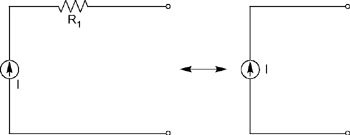
    1. A passive element in series with a current source is not a branch.


      Figure 3.1

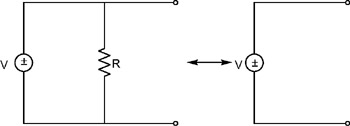
    2. A passive element in parallel with a voltage source is not a branch.


      Figure 3.2


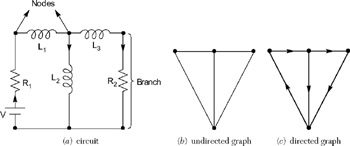
Figure 3.3

3.3 SOME USEFUL DEFINITIONS

3.3.1 Connected Graph

A graph is said to be connected if a path can be found between any two nodes of it. Figure 3.3(b) is aconnected graph. A graph whose branches are oriented is called a directed graph (Figure 3.3c), otherwise the graph is undirected as shown in Figure 3.3(b).

3.3.2 Linear Graph

A linear graph or simply a graph is a collection of nodes and branches. It shows...

UNLIMITED FREE
ACCESS
TO THE WORLD'S BEST IDEAS

SUBMIT
Already a GlobalSpec user? Log in.

This is embarrasing...

An error occurred while processing the form. Please try again in a few minutes.

Customize Your GlobalSpec Experience

Category: Bar Graph Arrays
Finish!
Privacy Policy

This is embarrasing...

An error occurred while processing the form. Please try again in a few minutes.