Network Analysis & Circuits

The network, the excitation, and the response. If any two of the three quantities are given, the third may be found for linear networks. If the network and the excitation are given and the response is to be determined, the problem is defined as analysis. When the excitation and the response are given, and it is required to determine a network, the problem is defined as synthesis. If the network and the response are given to find the excitation there is generally no accepted name and it is not common.
Synthesis is the process of finding a network corresponding to a given driving-point impedance or admittance. In this chapter, we will consider some aspects of passive network synthesis, mainly driving-point immittance functions (impedance or admittance functions),
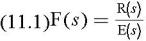
where F(s) is the network function, which is the ratio of response R(s) to the excitation E(s).
Analysis of a system is the investigation of properties and the behavior (response) of an existing system.
Design of a system is the choice and arrangement of system components to perform a specific task.
Design by analysis is accomplished by modifying the characteristics of an existing system.
Design by synthesis is accomplished by defining the form of the system directly from its specifications.
By Equation (11.1),
The first step in a synthesis procedure is to determine whether F(s) can be realized as a physical passive network. F(s) should be stable and satisfy the following conditions: