Oscillator Design and Computer Simulation, Second Edition
For this section, we assume that networks are linear and time invariant. Time invariant signifies that the network is constant with time. Linear signifies the output is a linear function of the input. Doubling the input driving function doubles the resultant output. The network may be uniquely defined by a set of linear equations relating port voltages and currents.
Consider the network in Figure 1-1A terminated at the generator with R g, terminated at the load with R l, and driven from a voltage source E g [1]. E l is the voltage across the load.
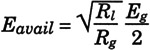
The quantity E avail is the voltage across the load when all of the available power from the generator is transferred to the load.
| (1.1) | ![]() |
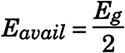
For the case of a null network with R l = Rg,
| (1.2) | ![]() |
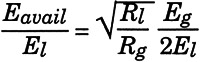
since one-half of E g is dropped across R g and one-half is dropped across R l. For the case of a non-null network, dividing both sides of the equation 1.1 by E l gives
| (1.3) | ![]() |
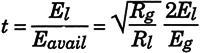
We can then define the voltage transmission coefficient as the voltage across the load, E l, divided by the maximum available voltage across the load E avail, or
| (1.4) | ![]() |
This voltage transmission coefficient is the "voltage gain" ratio. For the...