Oscillator Design and Computer Simulation, Second Edition
Two methods of oscillator analysis and design are considered in this book. One method involves the open-loop gain and phase response versus frequency. This Bode response [1] and nonlinear effects discussed later predict many aspects of oscillator performance. A second method considers the oscillator as a one- port with a negative real impedance to which a resonator is attached. The loop method provides a more complete and intuitive analysis while the negative resistance method is more suitable for broad tuning oscillators operating above several hundred megahertz.
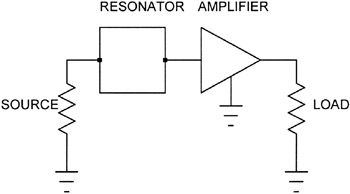
The loop method is studied first. Consider the amplifier-resonator cascade in Figure 2-1. The cascade is driven by a source with a resistance of Z o and is terminated in a load resistance of Z o. The gain (forward) at a given frequency is
| (2.1) | |
where C 21 is the magnitude of the forward-scattering parameter for the cascade at a given frequency. The transmission phase at a given frequency is the angle of C 21. If the cascade is matched at the input and output to Z o the magnitudes of C 11 and C 22, the input and output scattering parameters, are zero.
The gain-phase response for a typical cascade is given in Figure 2-2. The normal convention of the Bode response is to plot frequency on a logarithmic scale. Because oscillators typically operate over less than a decade of bandwidth, we...