Oscillator Design and Computer Simulation, Second Edition

2.4: Loaded Q

2.4 Loaded Q

The oscillator loaded Q is a critical parameter. The loaded Q is a direct indication of many oscillator performance parameters. A high loaded Q

  1. Reduces phase noise

  2. Reduces frequency drift

  3. Isolates performance from active-device variation

Phase noise is inversely proportional to the square of the loaded Q [4]. Drift is reduced because the resonator solely determines the oscillation frequency in high- Q designs. Isolating the resonator from active device reactances reduces the effect of temperature. Many oscillator designs have low loaded Qs. The phase noise and long-term stability of these designs are far from optimum. An oscillator with a low loaded Q is often the root problem even though designers offer imaginative and esoteric descriptions of the problem. Noise is discussed further in Chapter 4.

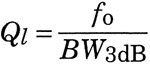
The open-loop loaded Q of a cascade is

(2.8)

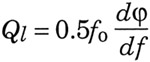
For the 100 MHz example the loaded Q is approximately 5.2. The loaded Q in terms of the phase slope is

(2.9)

where ? is in radians or

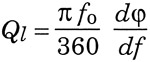
(2.10)

where ? is in degrees.

When the phase zero crossing does not occur at maximum phase slope, the loaded Q should be calculated using one of the latter two equations instead of using the amplitude response bandwidth. The loaded Q is less than optimum in that situation. If the phase zero crossing occurs at maximum phase slope, the first equation for loaded Q may be used.

UNLIMITED FREE
ACCESS
TO THE WORLD'S BEST IDEAS

SUBMIT
Already a GlobalSpec user? Log in.

This is embarrasing...

An error occurred while processing the form. Please try again in a few minutes.

Customize Your GlobalSpec Experience

Category: Q-switches
Finish!
Privacy Policy

This is embarrasing...

An error occurred while processing the form. Please try again in a few minutes.