Pneumatic Drives: System Design, Modelling and Control

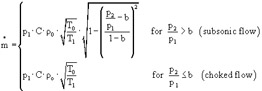
A model of the mass flow rate through a well rounded nozzle is derived in Chap. 4, based on first principles. To extend the analysis to the flow through a sharp edged orifice, it is necessary to introduce the discharge coefficient C d. For some limiting cases numerical values can analytically be found for this coefficient. For all relevant technical orifices, measurements or empirical models based on measurements are needed to determine the value. This observation motivated Sanville (1971) to look for approximations of Eqs. (4.17) and (4.21) to describe the flow rate through a pneumatic component, e.g. a nozzle or a control valve where the critical pressure ratio is typically much lower than for a nozzle. Generalising work from Purdue et al. (1969), Sanville proposed a model that later became the basis for the standard ISO 6358. The model has two parameters to describe the mass flow rate: the pressure ratio b and the sonic conductance C:
| (5.1) | |
| where | ? mass flow rate in kg/s, |
| p i upstream pressure in Pa, | |
| C sonic conductance in m 3/(s.Pa), | |
| ? 0 density of air at reference conditions in kg/m 3, | |
| T 0 temperature of air at reference conditions in K, | |
| T 1 upstream temperature of air in K, | |
| p 2 downstream pressure in Pa, | |
| b critical pressure ratio. |
This method to model the flow rate through a pneumatic component...