Pneumatic Drives: System Design, Modelling and Control

8.2: Mathematical Model

8.2 Mathematical Model

In order to simulate the piston movement and chamber pressures, a mathematical model is needed. As a result of large changes in pressure and density, the temperature of the air also changes and should be taken into account for a detailed model. A general model of a volume of gas consists of three equations: the energy equation, the conservation of mass equation and an equation of state, e.g. the ideal gas equation of state.

A lumped parameter approach will be taken assuming a homogeneous gas temperature [4]. Because of the low heat capacity of the air and the high heat capacity of the surrounding material of the barrel and rod, the temperature of the metallic parts can be regarded as constant. The pressure change rate is rather small compared with the velocity of sound and therefore the pressure in the chamber is assumed to be uniform. Kinetic and potential energy terms will be neglected (Ballard 1974:2.10 2.11).

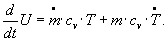
The derivation of the mathematical models [5] starts with the change of the internal energy U of the air in one chamber of the cylinder, given by

(3.6)

The change of the internal energy is also given by the energy change of the entering and leaving gas mass, c p T i ?, the mechanical work, p dV/dt, and the heat flow from the gas to the cylinder wall, h a ?T, which leads to

(8.3)

Combining Eqs. (3.6) and (8.3) leads to the mathematical model of the gas temperature

UNLIMITED FREE
ACCESS
TO THE WORLD'S BEST IDEAS

SUBMIT
Already a GlobalSpec user? Log in.

This is embarrasing...

An error occurred while processing the form. Please try again in a few minutes.

Customize Your GlobalSpec Experience

Category: Combustion Engines
Finish!
Privacy Policy

This is embarrasing...

An error occurred while processing the form. Please try again in a few minutes.