Overview
The great majority of pneumatic drives are operated in a binary mode: the rod is either completely extended or retracted. Systems that can stop at intermediate positions or move in a controlled way have been topic of research projects in the 1980s and are commercially available today but very rarely used for industrial automation.
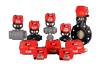
However, there is one area of automation where position controlled pneumatic actuators have been used for decades: for the actuation of process control valves. These valves manipulate a flowing fluid such as gas, steam, water or chemical compounds to keep process variables such as pressure, flow, level or temperature within a required range.
 Figure 19.1: Schematic view of a process control valve
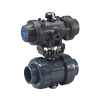
 The control valve, or more exactly the control valve assembly, consists of the valve body, the internal trim parts, an actuator to provide the force to operate the valve and a variety of additional valve accessories, among them a positioner. This is a servomechanism that is mechanically connected to the valve stem and that automatically adjusts its output to the actuator to maintain a desired stem position in proportion to the input signal.
A valve without positioner exhibits a considerable dead zone which is the range through which the input signal, i.e. the pressure in the actuator chamber, can be varied, upon reversal of direction, without initiating an observable change in the output signal, i.e. the position of the valve stem. A dead zone has many causes, but backlash in the control...


 TABLE OF CONTENTS