Pneumatic Drives: System Design, Modelling and Control

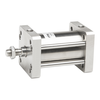
Cylinders convert pneumatic energy to mechanical work. They usually consist of a movable element such as a piston and piston rod, or plunger, operating within a cylindrical bore. Cylinders are often double-sided, i.e. pressurised air can work on both sides of the piston to extend or retract it, and they have mostly a single-ended piston rod.
A typical design is shown in Fig. 8.1. The piston rod is case hardened and chrome plated while the barrel is made of stainless steel or - for tie-rod cylinders - of an aluminium profile. Most cylinders have a band of magnetic material around the circumference of the piston and are fitted with a non-magnetic cylinder barrel. The magnetic field will travel with the piston as the piston rod moves in and out. By placing magnetically operated switches on the outside of the barrel, electronic control of the piston movement with a PLC is possible. Some means of stroke cushioning, i.e. gradual deceleration of the piston near to the end of its stroke, are provided by cushioning rings in the end position or elaborate pneumatic valve systems, see Chap. 8.1.
The symbol in Fig. 8.1 shows barrel, piston and rod. The arrow and the two rectangles beside the piston symbolise the adjustable cushioning.
In the 1950s, the first standards were issued to facilitate an interchange between different manufacturers, e.g. in the USA after a conference in Detroit 1951 as...