Pneumatic Drives: System Design, Modelling and Control

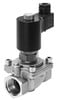
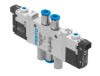
Today, a great majority of pneumatic drives is controlled by computers, both PLCs for on-off valves, embedded controllers or IPCs for continuous operation. These systems require the conversion of the electric signal output by the controller to a pneumatic signal, usually a pressure. Typically this is performed by a solenoid that converts the electric current to a force which opens or closes a flow path in a valve. For low power applications voice coils are used. For explosive environments where ultra low power operation is important piezoelectric devices are available.
Solenoids use the physical effect that current flowing through an electric conductor, e.g. an enamelled copper wire, generates a magnetic field. This magnetic field can be amplified by arranging the wire in the form of a coil with a great number of windings. An iron flux cage around the solenoid coil has a substantial impact on the resultant magnetic forces. The magnetic field generated by the solenoid coil causes a force of attraction on the magnetic core located at the centre which is also frequently referred to as the armature or in a 2/2-way valve as plunger which opens or closes a flow path. This principle is used in both on-off control valves and proportional control valves. However, the design of the solenoid differs considerably. In one case, a binary mode of operation is required, i.e. an either completely open or completely closed on-off valve. The switching has to be fast and the...