Pneumatic Drives: System Design, Modelling and Control

ISO 5598 defines a flow control valve as a "valve whose main function is to control the flow rate". The flow control action can be operative in one or both directions.
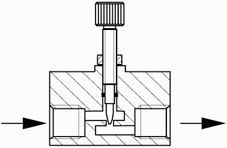
The simplest form of a flow control valve is a throttling valve, shown in Fig. 15.2. A needle's tapered nose is used to throttle the flow by reducing the cross-sectional area of the flow path. Simple tapers tend to produce a parabolic flow curve, whereas complex tapers tend to give 35 45 % increased flow per turn of the adjusting screw (Pinches and Callear 1999:92). Throttling valves can be used as shut-off valves, but overtorquing may score the nose and seat.
In our lab we use this kind of valve when measuring the flow characteristics of pneumatic components with two ports according to ISO 6358, see Fig. 5.2. To achieve a smooth opening or closing of the valve for the measurements, we connect a small DC motor with gear box to the turning knob and select the motor's supply voltage such that it takes several minutes to open or close the valve.
A one-way flow control valve or throttle/non-return valve allows free flow in one direction and controlled flow in the other direction. These valves are typically used for the speed control of cylinders. In many cases they are designed to be mounted direct at the cylinder ports. There are two...