(General References [5 9])
In about 1640, Otto von Guericke made the first piston-type vacuum pump (which he called "air pumps") patterned after the water pumps that had been used for many years to remove water from mines [10]. Figure 1 shows a woodcut picture of a mine being pumped out using several stages of water pumps. In 1654 von Guericke performed the famous "Magdeberg hemispheres" demonstration that really introduced the vacuum pump to the scientific world. In 1643 Torricelli demonstrated the mercury barometer based on the water manometer experiments of Berti (~1640). In 1662 Boyle formulated Boyle's Law, and in 1801 Dalton expressed the Law of Partial Pressures. Piston-type vacuum pumps came into widespread use, but vacuum experiments had to be continually pumped because of the poor vacuum seals available at that time.
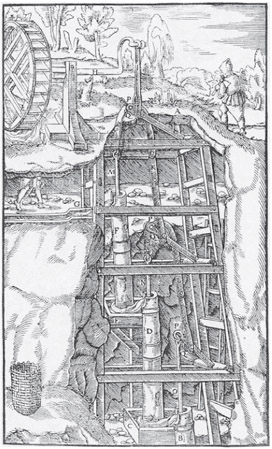 Figure 1: Multistage "syringe" water pumps removing water from a mine. From the book on mining, De Re Metallica (1556) [10].
 In the early to mid-1800s, heat-moldable, electrically insulating materials included gutta-percha, a material made from the sap of a tree native to Southeast Asia (F. Montgomery brought this to Europe, 1843); the molded plastic made from shellac and sawdust (and later coal dust) (H. Peck & C. Halvorson, Norway, 1850); and "India rubber," which was made from rubber tree sap, sulfur, and gum shellac (G. Goodyear, 1851). L. Baekeland invented "Bakelite," the first totally synthetic thermosetting plastic, in 1907. Glass forming (ancient) and porcelain fabrication (W. Bottger, Germany, 1710) were well understood by the mid-1800s.
Copyright Noyes Publications/William Andrew Publishing 2003 under license agreement with Books24x7


 TABLE OF CONTENTS