
Printed Circuit Card Signal Generators
Description
Printed Circuit Card Signal Generators are devices designed to produce electronic signals with specific characteristics. These signals can vary in waveform, frequency, and amplitude, and are used to test and validate the performance of electronic circuits and systems.
Working Principle
Printed Circuit Card Signal Generators operate by synthesizing signals through a combination of synthesis and solid-state oscillator technologies. These generators are controlled by microprocessors, allowing for precise frequency and level control, programmability, and self-diagnostics. This makes them highly useful for generating accurate and repeatable test signals, which are essential for validating and calibrating electronic circuits and systems.
Applications
Printed Circuit Card Signal Generators are used in a variety of applications. They are crucial in circuit development and maintenance, where they stimulate circuits to test and verify designs. They are also used in diagnosing faults by injecting signals at various points to identify and fix malfunctioning components. In educational settings, they serve as essential tools for teaching electronics and signal processing principles.
Advantages over other Signal Generators
One of the main advantages of Printed Circuit Card Signal Generators is their ability to produce precise, repeatable test signals, which are invaluable for validating and calibrating circuits. This ensures that the system's response can be accurately measured under consistent conditions. Additionally, their programmability and microprocessor control provide high levels of accuracy and low cost of ownership.
Limitations
While Printed Circuit Card Signal Generators offer many advantages, they may have limitations in terms of frequency range and modulation capabilities compared to more specialized signal generators. They might also be less suitable for applications requiring extremely high-frequency signals or complex modulation schemes.
Considerations
When considering Printed Circuit Card Signal Generators, it is important to evaluate initial costs, operating expenses, and maintenance requirements. These generators are generally durable and offer high accuracy, but the cost of replacement parts and maintenance should be factored into the overall cost of ownership. Additionally, the specific requirements of the application, such as frequency range and signal complexity, should be considered to ensure the generator meets the necessary specifications.
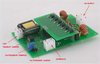
from Electro Optical Components, Inc.
QBD series Pockels cell drivers produce high voltage pulses with high repetition rates, fast risetimes (falltimes) and adjustable voltage amplitude. Drivers are available in two modifications: QBD-DN for pull-down scheme and QBD-UP for push-up scheme. Two control types are available: manual and... [See More]
- Form Factor: PCB
- Generator Type: Pulse
- Device Type: Generator
- Minimum: 0.1000

from Red Pitaya, d.o.o.
SDRlab 122-16 External clock is based on the SDRlab 122-16 model that is modified to be used with an external clock oscillator, which is important especially for RF applications that operate at other frequencies, require better quality clock or clock synchronization. [See More]
- Form Factor: Portable; PCB
- Generator Type: Continuous Wave; Function; Noise; Pulse; Sweep; Multiple Outputs; Synchronized Multiple Outputs; Signal
- Device Type: Generator
- Inputs: 2 to 4

from Red Pitaya, d.o.o.
SDRlab 122-16 was developed specifically for software-defined radio and more demanding RF applications. [See More]
- Form Factor: Portable; PCB
- Generator Type: Continuous Wave; Function; Noise; Pulse; Sweep; Multiple Outputs; Synchronized Multiple Outputs; Signal
- Device Type: Generator
- Inputs: 2 to 4

from Red Pitaya, d.o.o.
SIGNALlab 250-12 is most sophisticated Red Pitaya product, built for more demanding industrial applications and research, where robustness and performance matter more than cost. [See More]
- Form Factor: Portable; PCB
- Generator Type: Continuous Wave; Function; Noise; Pulse; Sweep; Multiple Outputs; Synchronized Multiple Outputs; Signal
- Device Type: Generator
- Inputs: 2 to 4

from Red Pitaya, d.o.o.
SIGNALlab 250-12 is most sophisticated Red Pitaya product, built for more demanding industrial applications and research, where robustness and performance matter more than cost. [See More]
- Form Factor: Portable; PCB
- Generator Type: Continuous Wave; Function; Noise; Pulse; Sweep; Multiple Outputs; Synchronized Multiple Outputs; Signal
- Device Type: Generator
- Inputs: 2 to 4
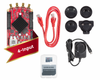
from Red Pitaya, d.o.o.
STEMlab 125-14 4 Inputs is based on STEMlab 125-14 board, but instead of 2 inputs and 2 output channels offers 4 Input channels that with improved performance. [See More]
- Form Factor: Portable; PCB
- Generator Type: Continuous Wave; Function; Noise; Pulse; Sweep; Multiple Outputs; Synchronized Multiple Outputs; Signal
- Device Type: Generator
- Inputs: 4
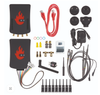
from Red Pitaya, d.o.o.
STEMlab 125-14 is our most versatile and popular product, which was introduced to the market in 2013 when Red Pitaya was established. Since then it has been used in a wide variety of contexts, from hobbyists and ham radio operators to industry, research, and space applications. [See More]
- Form Factor: Portable; PCB
- Generator Type: Continuous Wave; Function; Noise; Pulse; Sweep; Multiple Outputs; Synchronized Multiple Outputs; Signal
- Device Type: Generator
- Inputs: 2 to 4
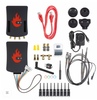
from Red Pitaya, d.o.o.
STEMlab 125-14 is our most versatile and popular product, which was introduced to the market in 2013 when Red Pitaya was established. Since then it has been used in wide variety of contexts, from hobbyists and ham radio operators to industry, research and space applications. [See More]
- Form Factor: Portable; PCB
- Generator Type: Continuous Wave; Function; Noise; Pulse; Sweep; Multiple Outputs; Synchronized Multiple Outputs; Signal
- Device Type: Generator
- Inputs: 2 to 4
from Red Pitaya, d.o.o.
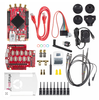
STEMlab 125-14 Edu Pack is based on Red Pitaya's best-selling DAQ platform and with the chosen accessories a perfect fit for educational purposes. [See More]
- Form Factor: Portable; PCB
- Generator Type: Continuous Wave; Function; Noise; Pulse; Sweep; Multiple Outputs; Synchronized Multiple Outputs; Signal
- Device Type: Generator
- Inputs: 2 to 4

from Red Pitaya, d.o.o.
STEMlab 125-14 External clock is based on the STEMlab 125-14 model that is modified to be used with an external clock oscillator, which is important especially for RF applications that operate at other frequencies, require better quality clock or clock synchronization. With this modification, users... [See More]
- Form Factor: Portable; PCB
- Generator Type: Continuous Wave; Function; Noise; Pulse; Sweep; Multiple Outputs; Synchronized Multiple Outputs; Signal
- Device Type: Generator
- Inputs: 2 to 4