
Stepper CNC Controllers
Description
Stepper CNC Controllers are devices that manage the operation of stepper motors in CNC (Computer Numerical Control) systems. These controllers send precise command pulses to the stepper motors, allowing them to rotate in discrete steps. This precise control enables the motors to achieve accurate positioning and movement, which is essential for tasks that require high precision.
Working Principle
Stepper CNC Controllers work by sending electrical pulses to the stepper motor, which then moves in fixed increments or steps. Each pulse corresponds to a single step, and the motor's position is determined by the number of pulses received. This open-loop system does not require feedback mechanisms, as the position is inherently known by the number of steps taken. The controllers are useful because they provide precise control over the motor's position and speed, making them ideal for applications that require exact movements and positioning.
Applications
Stepper CNC Controllers are widely used in various applications, particularly in manufacturing and robotics. For example, they are integral to the operation of 3D printers, where they control the movement of the print head along the X, Y, and sometimes Z axes. This precise control allows for the accurate layering of materials to create 3D objects. Additionally, they are used in CNC machines for tasks such as milling, cutting, and engraving, where precise control over tool movement is crucial.
Advantages over other CNC Controllers
Stepper CNC Controllers offer several advantages over other types of CNC controllers. They are generally more cost-effective and provide high torque output without the need for complex feedback systems like encoders. Their brushless operation reduces maintenance needs and increases reliability. Unlike DC Brush or Brushless DC motors, stepper motors do not require a servo control loop, simplifying the control system and reducing costs.
Limitations
Despite their advantages, Stepper CNC Controllers have some limitations. They typically operate at lower speeds compared to other motor types, which can be a drawback in applications requiring high-speed operations. They are also susceptible to vibrations and resonance at certain speeds, which can affect performance. Additionally, while they offer precise control, they require specialized driver circuits for proper operation, adding complexity to the system.
Considerations
When considering Stepper CNC Controllers, several factors should be taken into account. Initial costs are generally lower compared to other CNC controllers, but operating expenses can vary depending on the specific application and usage. Durability is typically high due to their brushless design, but accuracy can be affected by factors such as resonance and load. Replacement and maintenance costs are generally low, as the lack of brushes reduces wear and tear. However, the need for specialized driver circuits can increase the complexity and cost of maintenance.
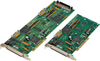
from Galil
The DMC-18x0 PCI motion controller is a member of the Optima Series, Galil's prior-generation, multi-axis motion controllers. The DMC-18x0 controller accommodates 1- through 8-axis formats and allows control of step or servo motors on any combination of axes. Any mode of motion can be programmed... [See More]
- Motor: Servo; Stepper
- Number of Axes: 1 Axis
- Applications: Horizontal Mills; Vertical Mills; Lathes and Turning Centers; Grinders; Electro-Discharge Machine; Torch Table; Welding; Inspection
- Configuration: Computer Board