
Rigid Tapping CNC Controllers
Description
Rigid tapping CNC controllers are specialized devices used in CNC machines to precisely control the tapping process. They ensure that the tap is fed into a workpiece at the exact rate required to create a perfectly tapped hole. This precision is achieved by synchronizing the spindle speed with the feed rate, allowing for accurate and consistent thread formation.
Working Principle
The working principle of rigid tapping involves the synchronization of the spindle speed and the tapping feed rate. This synchronization is crucial because it ensures that the tap enters the workpiece at the correct speed and depth, preventing issues such as thread distortion or tap breakage. Unlike traditional tapping methods that use floating tap holders, rigid tapping eliminates the need for axial flexibility, providing a more stable and precise tapping process. This makes rigid tapping particularly useful for applications requiring high precision and repeatability.
Applications
Rigid tapping CNC controllers are widely used in industries where precise threading is essential. Specific examples include the automotive and aerospace industries, where components often require accurately tapped holes for assembly. In automotive assembly lines, rigid tapping is employed to ensure that engine components and other critical parts are manufactured with the necessary precision. Similarly, in the aerospace industry, rigid tapping is used to produce components that meet stringent safety and performance standards.
Advantages over other CNC Controllers
Rigid tapping offers several advantages over traditional CNC controllers with floating tap holders. One significant advantage is the ability to maintain precise thread depth, which is particularly challenging with floating tap holders. This precision reduces the likelihood of errors and rework, leading to increased productivity and cost savings. Additionally, rigid tapping eliminates the need for specialized tapping heads, simplifying the setup and reducing equipment costs.
Limitations
Despite its advantages, rigid tapping has some limitations. One limitation is the requirement for precise synchronization between the spindle speed and feed rate, which can be challenging to achieve in some CNC machines. Additionally, rigid tapping may not be suitable for all materials or applications, particularly those involving very hard or brittle materials that require more flexibility in the tapping process.
Considerations
When considering the implementation of rigid tapping CNC controllers, several factors should be taken into account. Initial costs can be higher due to the need for specialized controllers and software. However, these costs may be offset by the increased productivity and reduced error rates. Operating expenses may also be lower due to the elimination of specialized tapping heads and reduced rework. Durability and accuracy are generally high with rigid tapping, but regular maintenance is essential to ensure continued performance. Replacement and maintenance costs should be factored into the overall cost-benefit analysis when deciding to implement rigid tapping in a manufacturing process.
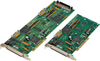
from Galil
The DMC-18x0 PCI motion controller is a member of the Optima Series, Galil's prior-generation, multi-axis motion controllers. The DMC-18x0 controller accommodates 1- through 8-axis formats and allows control of step or servo motors on any combination of axes. Any mode of motion can be programmed... [See More]
- Control Function: Polar Coordinates (optional feature); Cutter Compensation (optional feature); Circular and Linear Interpolation; Helical Interpolation (optional feature); Canned Cycles; Scaling (optional feature); Rigid Tapping; Contouring, ECAM
- Number of Axes: 1 Axis
- Applications: Horizontal Mills; Vertical Mills; Lathes and Turning Centers; Grinders; Electro-Discharge Machine; Torch Table; Welding; Inspection
- Motor: Servo; Stepper