
Cone Type Liquid Flow Meters
Description
Cone Type Liquid Flow Meters are designed to measure the flow rate of liquids by utilizing a cone-shaped element within the flow path. This design helps in shaping the flow profile and stabilizing the measurement signal, ensuring accurate flow rate readings.
Working Principle
Cone Type Liquid Flow Meters operate on the principle of differential pressure. A V-shaped conical intrusion is centrally positioned in the pipeline, redirecting the fluid to flow around the cone rather than through a central orifice. This setup creates a pressure drop across the cone, which is measured by pressure sensing taps located upstream and downstream of the cone. The difference in pressure is used to calculate the flow rate. This design is beneficial as it provides a stable measurement signal and minimizes wear on the cone edge, enhancing the meter's durability and reliability .
Applications
Cone Type Liquid Flow Meters are particularly useful in situations where space is limited, such as retrofitting into existing piping networks with minimal straight pipe runs. They are also employed in environments requiring high performance over a wide range of flow rates, such as in industrial settings where the Reynolds Numbers are approximately 5,000–6,000 and higher .
Advantages over other Liquid Flow Meters
One of the key advantages of Cone Type Liquid Flow Meters is their simplicity and ease of use. Unlike Coriolis meters, which have more individual parts and require more complex operational procedures, Cone Type meters can often be troubleshooted remotely without the need for physical inspection. Additionally, they have a long lifespan of over 25 years and require virtually no maintenance, making them a cost-effective choice in the long run. Their design also allows for a low total head loss compared to other differential pressure meters, and they can accommodate various transmitters to measure multiple variables .
Limitations
A notable limitation of Cone Type Liquid Flow Meters is their inability to measure multiphase flow. This restricts their use in applications where the fluid contains multiple phases, such as gas-liquid mixtures .
Considerations
When considering Cone Type Liquid Flow Meters, it is important to evaluate the initial costs, which may be higher due to their specialized design. However, the long-term operating expenses are generally lower due to their minimal maintenance requirements and long lifespan. The accuracy of these meters is high, but it is crucial to ensure that they are installed correctly to maintain this accuracy. Replacement and maintenance costs are low, given their durable construction and the minimal wear on the cone edge .
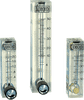
from KOBOLD Instruments, Inc.
Product Features. Easy to Read Scales. Water Range 0.003 to 20 GPM. Air Range 0.002 to 100 SCFM. Measuring Ranges 0.2-2 GPH...2-20 GPM water 0.1-1 SCFH...10-100 SCFM air. Durable One-Piece Construction. Low Cost. Metric Scales Available. The KFR line of flowmeters offers the perfect balance between... [See More]
- Meter Technology: Cone
- Operating Pressure: 100
- Process Media Type: Liquid; Gas
- Media Temperature: 150

from OMEGA Engineering, Inc.
The HPF-110/120 series are compact, lightweight, self-contained portable testers with laboratory accuracy. Designed for fast diagnostic troubleshooting of all types of mobile or stationary hydraulic systems and components, makes all flow, pressure and temperature measurements simultaneously from one... [See More]
- Meter Technology: Cone; Turbine
- Operating Pressure: 6000
- Process Media Type: Liquid
- Media Temperature: 302