
Analog Current Color Sensors
Description
Analog Current Color Sensors are devices designed to detect and measure the color of an object by analyzing the light reflected from it. These sensors typically operate by converting the detected light into an analog current signal, which can then be processed to determine the color characteristics of the object.
Working Principle
Analog Current Color Sensors work by shining a light onto the object to be monitored and measuring the reflected light. The reflected light is refracted into its spectral components, often using filters that allow only specific parts of the spectrum to pass through. This process mimics the principle of the human eye, allowing the sensor to detect and measure the intensity of different colors. The sensors are particularly useful because they can provide precise color recognition and measurement, which is essential in applications where accurate color differentiation is critical.
Applications
Color sensors are generally used for true color recognition and color mark detection. In true color recognition, sensors are required to distinguish between different colors or shades of a specific color. They can be used in sorting applications, where the output is activated when the object is close to the set color, or in matching applications, where the output is activated when the object matches the stored color within a tolerance. These sensors are commonly used in industrial and consumer applications, such as adjusting backlighting in consumer electronics and notebook computers, and ensuring consistent true color and brightness levels in displays.
Advantages over other Color Sensors
Analog Current Color Sensors offer precise color recognition and measurement, which can be more accurate than some other types of color sensors. They are capable of differentiating between subtle color variations, making them ideal for applications requiring high precision. Additionally, their ability to operate under varying lighting conditions and maintain stable output under changing temperatures provides an advantage in environments where conditions are not constant.
Limitations
One limitation of Analog Current Color Sensors is that they may require calibration to ensure accuracy, especially in environments with fluctuating lighting conditions. Additionally, these sensors might not be suitable for applications requiring digital output, as they provide an analog current signal that needs further processing.
Considerations
When considering the use of Analog Current Color Sensors, it is important to evaluate the initial costs, which can vary depending on the complexity and precision of the sensor. Operating expenses may include the need for regular calibration and maintenance to ensure accuracy. Durability is another factor, as sensors used in harsh environments may require more frequent replacement. Accuracy is a key consideration, as the sensor's ability to differentiate between colors can impact the quality of the application. Finally, replacement and maintenance costs should be factored into the overall cost of ownership, as these can vary based on the sensor's design and the environment in which it is used.

from Festo Corporation
Reading 1D barcodes, 2D matrix codes and directly marked codes. Equipped with position tracking and additional inspection algorithms. High resolution of 1.3 megapixels. Quick and powerful recognition algorithms. BLOB function for position sensing, quality inspection or counting multiple parts in the... [See More]
- Output Options: Analog Current; Switch or Relay; Digital (NPN, PNP)
- Operating Temperature: 32 to 122
- Color Types Detected: RGB (Visible)
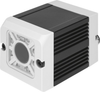
from Festo Corporation
Vision sensor with integrated lighting/lens. Enables reading of 1D/2D codes or quality inspection of parts. Intuitive software for simple parameter setting. All-in-one device with integrated lens, lighting, evaluation, and communication [See More]
- Output Options: Analog Current; Switch or Relay; Digital (NPN, PNP)
- Operating Temperature: 32 to 122
- Color Types Detected: RGB (Visible)

from Festo Corporation
Diffuse scan. Block design. Electrical connection via M12x1 plug, 8-pin. Display via 7 LEDs [See More]
- Output Options: Analog Current; Switch or Relay
- Sensing Range: 32
- Color Types Detected: RGB (Visible)
- Operating Temperature: 14 to 131

from CARLO GAVAZZI Automation Components
The Colour Sensor is a fibre optic amplifier made specifically for recognition of 1 or 1 to 4 colours. Teaching of the colours is easily performed by means of the “Teach-in ” function. Each colour has a separate output which can be delayed up to 5 sec by means of the built-in timer. The... [See More]
- Output Options: Analog Current; Switch or Relay
- Color Types Detected: RGB (Visible)
- Application Type: True Color Recognition
- Number Of Colors Detected: 4

from Shanghai Lanbao Sensing Technology Co., Ltd.
Lanbao new color mark sensor; Built-in RGB three-color light source color mode and color mark mode; The detection distance is 3 times that of similar color mark sensors; The detection return difference is adjustable, which can eliminate the influence of jitter of the measured object; Light spot size... [See More]
- Output Options: Analog Voltage; Analog Current
- Sensing Range: 28
- Application Type: Color Mark Detection
- Light Source: LEDs

from Banner Engineering Corp.
Overview. Detects the most difficult color mark contrasts, including 20% yellow on white. Features two lens positions and a choice of sensing image orientations. Available with a green, blue, red or white LED. Offers easy push-button setup with remote programming capability for R55 Expert models. [See More]
- Output Options: Analog Current; Digital (NPN, PNP)
- Color Types Detected: RGB (Visible)
- Application Type: Color Mark Detection
- Number Of Colors Detected: 4
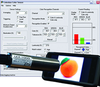
from EMX Industries, Inc.
The LEX-1000 Color Light Measurement Sensor measures the relative color characteristics of a wide variety of light sources and illuminated objects. The Color Light Measurement Sensor is the perfect solution for: Evaluation of all visible light sources,. Comparative light measurement,. LED, relative... [See More]
- Output Options: Analog Current
- Color Types Detected: RGB (Visible)
- Application Type: True Color Recognition
- Number Of Colors Detected: 3
from Optex FA
Digital display FO Amp Red LED PB Teach Analog Out [See More]
- Output Options: Analog Current; Pulse Train; Digital (NPN, PNP)
- Sensing Range: 450
- Application Type: Color Mark Detection
- Light Source: LEDs; Fiber Optic; GreenLED
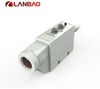
from Shanghai Lanbao Sensing Technology Co., Ltd.
Lanbao new color mark sensor; Built-in RGB three-color light source color mode and color mark mode; The detection distance is 3 times that of similar color mark sensors; The detection return difference is adjustable, which can eliminate the influence of jitter of the measured object; Light spot size... [See More]
- Output Options: Analog Voltage; Analog Current
- Sensing Range: 28
- Application Type: Color Mark Detection
- Light Source: LEDs

from EMX Industries, Inc.
Verify the presence of targets that can be differentiated by color, faster and with greater control. A ColorMax-1000 ™ color sensor lets your machine see up to 15 colors and RGB intensity. What's more, innovative technology improves sensitivity and speed, so you can maximize the pace of... [See More]
- Output Options: Analog Voltage; Analog Current; Serial
- Color Types Detected: RGB (Visible)
- Application Type: True Color Recognition; Color Mark Detection; Color Verification
- Number Of Colors Detected: 4