
Products & Services
See also: Categories | Featured Products | Technical Articles | More Information-
Supplier: Shanghai Optics
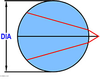
Description: focal length, back focal length, and index of refraction of the ball are all parameters you will need to keep in mind as you design a setup that involves a ball lens. The effective focal length is equal to the index of refraction (denoted here by n) times the diameter of the
- Lens Type: Ball Lens, Spherical Lens
- Lens Application: Ultraviolet, Visible
-
Supplier: Tower Optical Corporation
Description: Ball lenses are used for various tasks such as improving the coupling between optical fibers and the emitters or detectors they interface with. Standard size lenses range from 1.0mm to 5.0mm. Custom made sizes or special materials are also available. All Ball lenses can be ordered with
- Diameter / Length: 1 to 10.000000000000002 mm
- Diameter: 1 to 10.000000000000002 mm
- Surface Quality: 40-20 Scratch / Dig
- Lens Features: Antireflection Coating
-
Supplier: Ross Optical Industries
Description: Ball lenses are highly transparent spheres made of optical glasses. They are used to focus light into fibers as in diode laser-to-fiber coupling as well as fiber-to-fiber coupling. They have high coupling efficiency and should be much easier to align than traditional lenses due to their
- Diameter / Length: 8 mm
- Lens Features: Antireflection Coating, Laser / Heat Resistant
- Lens Type: Ball Lens
- Lens Application: Infrared, Ultraviolet, Visible
-
-
Supplier: UNI OPTICS(Fujian) Co., Ltd
Description: Ball Lenses are commonly used to improve signal quality in fiber coupling applications, or for use in endoscopy or bar code scanning applications. Ball Lenses feature short back focal lengths to minimize the distance needed from the Ball Lens to the optical fiber. Uni
- Diameter / Length: 1 to 10.000000000000002 mm
- Diameter: 1 to 10.000000000000002 mm
- Lens Type: Ball Lens, Spherical Lens
- Materials: UV Grade Fused Silica
-
Supplier: Changchun Sunday Optics Co., Ltd.
Description: With the roof surface, these prisms are used to invert and reverse the image.A roof prism may be used to revert and invert the image as well as bend the line of sight through a 90 degree angle, We provide roof right angle prisms, roof penta or half penta prisms, Schmidt prisms, or other roof prism
- Diameter / Length: 0.30000000000000004 to 50 mm
- Surface Quality: 40-20 Scratch / Dig
- Lens Features: Antireflection Coating
- Lens Type: Ball Lens
-
Supplier: Changchun Sunday Optics Co., Ltd.
Description: CPV Solar Power Prisms is used to collect the sunlight, for solar condenser, solar energy concentrating photovoltaic (CPV) system, solar power generation, etc., which is the main optical component when solar power transform to electric energy.
- Diameter / Length: 0.30000000000000004 to 50 mm
- Surface Quality: 40-20 Scratch / Dig
- Lens Features: Antireflection Coating
- Lens Type: Ball Lens
-
Supplier: Changchun Sunday Optics Co., Ltd.
Description: Right angle prisms are used to deflect a light beam with 90 or 180°. Prisms are widly used in optical system, which can reflect, deviate and rotate beams of light as well as dispersing their wavelengths.Right angle prisms are usually coated with Reflective coating when used.It has a larger contact
- Diameter / Length: 0.30000000000000004 to 200 mm
- Surface Quality: 40-20 Scratch / Dig
- Lens Features: Antireflection Coating
- Lens Type: Ball Lens
-
Supplier: Artifex Engineering
Description: Most useful when coating is not an issue. Very tight diameter tolerance for accurate fibre coupling.
- Diameter / Length: 10.000000000000002 mm
- Surface Quality: 40-20 Scratch / Dig
- Materials: BK7 Glass
- Lens Type: Ball Lens
-
Supplier: Chonghong Industries(Microwork)Ltd.
Description: Sapphire balls & half balls in various sizes as per AFBMA Grades and Tolerances. We can reach the groundness precision to Grade 3 Each ball is checked 100% for size accuracy & polish aspects before delivery. Customized packaging options are available as per customer’s needs.
- Lens Type: Ball Lens
- Features: Other
-
Supplier: Changchun Sunday Optics Co., Ltd.
Description: Wedge prism has plane inclined surfaces. It deflects light toward its thicker portion. It can be used individually to deflect a beam to a special angle. Two wedge prisms work together can assembly an anamorphic prism to correct the elliptical shape of laser beam. The wedge prism is ideal for laser
- Diameter / Length: 0.30000000000000004 to 50 mm
- Surface Quality: 40-20 Scratch / Dig
- Lens Features: Antireflection Coating
- Lens Type: Ball Lens
-
Supplier: Chonghong Industries(Microwork)Ltd.
Description: Ruby balls & half balls in various sizes as per AFBMA Grades and Tolerances. We can reach the groundness precision to Grade 3 Each ball is checked 100% for size accuracy & polish aspects before delivery. Customized packaging options are available as per customer’s needs.
- Lens Type: Ball Lens
- Materials: Sapphire
-
Supplier: Knight Optical (UK) Ltd
Description: transmission between 185nm to 2000+nm, while our sapphire lens have a higher refractive index, allowing a very short fall back length to better facilitate fibre coupling. We can supply ball lens in a range of alternative materials and diameters. We are able to supply high
- Diameter / Length: 0.0025 mm
- Surface Quality: 40-20 Scratch / Dig
- Materials: BK7 Glass
- Lens Type: Ball Lens
-
Supplier: Edmund Optics Inc.
Description: chemical properties are basically the same, their optical properties are somewhat different. Sapphire has superior optical transmission qualities. Ruby Balls are easier to see and therefore easier to handle for physical applications.For general information about ball lens, as
- Diameter / Length: 2.7800000000000002 mm
- Lens Type: Ball Lens
- Materials: Sapphire
-
Supplier: Edmund Optics Inc.
Description: chemical properties are basically the same, their optical properties are somewhat different. Sapphire has superior optical transmission qualities. Ruby Balls are easier to see and therefore easier to handle for physical applications.For general information about ball lens, as
- Diameter / Length: 1.58 mm
- Lens Type: Ball Lens
- Materials: Sapphire
-
Supplier: Edmund Optics Inc.
Description: chemical properties are basically the same, their optical properties are somewhat different. Sapphire has superior optical transmission qualities. Ruby Balls are easier to see and therefore easier to handle for physical applications.For general information about ball lens, as
- Diameter / Length: 2 mm
- Lens Type: Ball Lens
- Materials: Sapphire
-
Supplier: Edmund Optics Inc.
Description: chemical properties are basically the same, their optical properties are somewhat different. Sapphire has superior optical transmission qualities. Ruby Balls are easier to see and therefore easier to handle for physical applications.For general information about ball lens, as
- Diameter / Length: 1.58 mm
- Lens Type: Ball Lens
- Materials: Sapphire
-
Supplier: Knight Optical (UK) Ltd
Description: transmission between 185nm to 2000+nm, while our sapphire lens have a higher refractive index, allowing a very short fall back length to better facilitate fibre coupling. We can supply ball lens in a range of alternative materials and diameters. We are able to supply high
- Diameter / Length: 0.0025 mm
- Surface Quality: 40-20 Scratch / Dig
- Materials: BK7 Glass
- Lens Type: Ball Lens
-
Supplier: Knight Optical (UK) Ltd
Description: transmission between 185nm to 2000+nm, while our sapphire lens have a higher refractive index, allowing a very short fall back length to better facilitate fibre coupling. We can supply ball lens in a range of alternative materials and diameters. We are able to supply high
- Diameter / Length: 0.0025 mm
- Surface Quality: 40-20 Scratch / Dig
- Materials: BK7 Glass
- Lens Type: Ball Lens
-
Supplier: Knight Optical (UK) Ltd
Description: transmission between 185nm to 2000+nm, while our sapphire lens have a higher refractive index, allowing a very short fall back length to better facilitate fibre coupling. We can supply ball lens in a range of alternative materials and diameters. We are able to supply high
- Diameter / Length: 0.0025 mm
- Surface Quality: 40-20 Scratch / Dig
- Materials: BK7 Glass
- Lens Type: Ball Lens
-
Supplier: Newport MKS
Description: The 561-BL2 Ball Lens Module attaches 2 mm diameter ball lenses to a 561 Series stage. The ball lens module is gently held in a 561-MM Module Mount.
-
Supplier: Newport MKS
Description: The 561-BL3 Ball Lens Module attaches 3 mm diameter ball lenses to a 561 Series stage. The ball lens module is gently held in a 561-MM Module Mount.
-
Supplier: Newport MKS
Description: The 561-BL1 Ball Lens Module attaches 1 mm diameter ball lenses to a 561 Series stage. The ball lens module is gently held in a 561-MM Module Mount.
-
Supplier: Accuris
Description: TESTER, LENS, IMPACT RESISTANCE, DROP BALL TYPE
-
Supplier: Suzhou Sujing Crystal Element Co.,Ltd
Description: Used for precision measuring instrument probe, high pressure pump, liquid chromatography and valve ball, bearing for ball, pen bead, etc
- Lens Type: Ball Lens
- Lens Application: Infrared, Ultraviolet, Visible
- Materials: Sapphire
-
Supplier: SAE International
Description: This slash sheet defines the design, performance, and interoperability requirements for fiber optic expanded beam, ball lens, single-mode pin termini installed in size 16 cavity connectors.
-
Description: options: uncoated, MgF2 single layer AR coating, laser line V-coating and BBAR coating • Diameter range : 5mm to 300mm An Aspheric Lens is an optical lens with the geometries of a non-spherical optical front (that is, the radius of curvature varies with the distance from the optical
- Diameter / Length: 5.000000000000001 to 300.00000000000006 mm
-
Supplier: Changchun Yutai Optics Co., Ltd.
Description: applications of sapphire balls? Widely used in laser systems, optical sensors, medical equipment, scientific research experiments, industrial testing instruments and high-precision optical systems. What are the advantages of sapphire balls? Sapphire balls are ideal for optical
- Surface Quality: 40-20 Scratch / Dig
- Lens Type: Ball Lens
- Materials: Sapphire
-
Supplier: Changchun Yutai Optics Co., Ltd.
Description: mature, can not achieve perfect coating of the whole ball body. Reflective Coating: Yutai Optics is currently able to provide localized coating of the ball lens (less than half the area of the ball).
- Surface Quality: 40-20 Scratch / Dig
- Lens Features: Antireflection Coating
- Materials: BK7 Glass
- Lens Type: Ball Lens
-
Supplier: Lighting Plastics of Minnesota, Inc.
Description: Product Description Composite lens consisting of a prismatic acrylic lens and a protective polycarbonate shielding. The perimeter of the lens is sealed by a specially designed channel which is chemically welded. Designed for areas where vandalism or accidental damage may be a
-
Supplier: Changchun Yutai Optics Co., Ltd.
Description: Half-Ball (hemispherical) lenses have a good performance on microscopy, endoscopy, fiber communication, optical pick-up devices, and laser measurement systems, LED industry, especially for high power and UV LED. Half balls are with much more advantages than silicone lenses and plastic
- Surface Quality: 40-20 Scratch / Dig
-
Description: Silica), Germanium, Zinc Selenide, Silicon, etc. These aspheric lenses are manufactured using Computer Numerical Control (CNC) precision polishing and grinding, which allows larger lens dimensions, tighter geometric control, and beam qualities. The MRF technique is also employed to achieve
- Diameter / Length: 5.000000000000001 to 390 mm
- Lens Features: Antireflection Coating
-
Description: plano-convex/Plano-concave lenses, ball/half lenses, meniscus lenses, biconvex/biconcave lenses, achromatic lenses, etc. The diameters are available between 5mm and 300mm. Custom coating options for Shalom’s aspheric lenses include uncoated substrates, Broadband Anti-reflection (BBAR)
- Diameter / Length: 5.000000000000001 to 300.00000000000006 mm
-
Supplier: Swiss Jewel Company
Description: We offer a range of optical and technical glass balls made mostly from Schott and Ohara materials. Below we list BK7, LASFN9, and LAF22 and we can supply other materials very quickly. The ball lenses can also be AR coated to minimize reflection thereby increasing transmission. We also
- Features: Corrosion Resistant, Dielectric / Electrically Insulating, Specialty / Other
- Ball Type: Glass Balls
-
Supplier: Newport MKS
Description: The LB5 Spherical Ball Micro Lens is an uncoated, 5.0 mm diameter, spherical ball lens with a 2.75 mm focal length, a 0.25 mm working distance, and a 4.0 mm clear aperture. Spherical ball lenses are commonly used for laser collimating and focusing, laser-to-fiber
- Diameter / Length: 5.000000000000001 mm
- Lens Type: Ball Lens
- Materials: LaSFN9 Glass
- Features: Other









Find Suppliers by Category Top
Featured Products Top
-

Transparent spherical balls, crafted from glass or optical materials, serve as beam collimators for optical fibers. They facilitate signal coupling between emitters, detectors, and fibers, with applications spanning endoscopy, optical sensors, and barcode scanning. Material selection hinges on numerical aperture, with prevalent choices being UV-grade fused silica, sapphire, and BK7 glass.
(read more)
Browse Optical Lenses Datasheets for Avantier Inc. -
Biconvex/Double Convex Lenses Plano Convex Lens Ball Lens (read more)
Browse Optical Lenses Datasheets for Avantier Inc. -
Low scattering: fused silica has good optical uniformity, which reduces light scattering and improves imaging quality. What are the applications of half ball lenses? 1. Microscopes and imaging systems: half ball lenses can be used in microscopes (read more)
Browse Optical Lenses Datasheets for Changchun Yutai Optics Co., Ltd. -
What are the applications of sapphire balls? Widely used in laser systems, optical sensors, medical equipment, scientific research experiments, industrial testing instruments and high-precision optical systems. What are the (read more)
Browse Ball Lenses Datasheets for Changchun Yutai Optics Co., Ltd. -
Harnesses Ball Bearings Roller Bearings (Tapered, Cylindrical, Spherical, Needle) Gear & Splines Wire and Cable Transducers - LVDT / Glass Scales Semiconductors Optics and Lenses Gage Calibrations Threaded (read more)
Browse Datasheets for Pratt & Whitney Measurement Systems, Inc. -
-Micromotors, Brushless DC-Servomotors or Stepper Motors also make it possible to convert the rotational movement into linear stroke or tensile movements. The use of ball screws in the series BS 22-1.5 enables linear movements with (read more)
Browse Stepper Motors (rotary) Datasheets for FAULHABER MICROMO
Conduct Research Top
-
Ball Lenses, A.F.B.M.A. Grade Terminology and Tolerances.
Helpful information sheet (with table) on ball lenses, A.F.B.M.A. grade terminology and tolerances
-
Lens Selection Guide
This article enumerated the different lens classifications including plano-convex lens, plano-concave lens, double-convex lens, double-concave lens, meniscus lens, ball/half-ball lens, achromatic doublet lens, cylindrical plano-convex lens/plano-concave lens, rod lens, and aspheric lens, exploring
-
Optical Thin Films on Complex Substrate Geometries Enabled by Enhanced Deposition Technology
TM coating process, designed by Deposition Sciences, Inc. (DSI (R)), is being used to produce exceptionally conformal coatings on complex substrate geometries, enabling a myriad of new applications that require uniform, multi-layer coatings on complex shapes, ranging from simple ball lenses
-
EETimes.com | Electronics Industry News for EEs & Engineering Managers
) Commentary & analysis of week's chip news ASML endorses Carl Zeiss' spin-off of lens unit as public company OBERKOCHEN, Germany -- Don't expect any major changes in the relationship between ASM Lithography and its main supplier of polished lenses after Carl Zeiss Jena GmbH here completes a planned spin off
More Information Top
 Indicates content that may require registration and/or purchase.

-
Design simulation and optimization of micro-optical components
result in the finding that spherical aberration is the optical effect dominating the coupling loss of micro-optical systems with ball lenses as imaging elements.
-
FY 2005 Miniature Spherical Retroreflectors Final Report
2.1 Simple Ball Lens ...............................................................................................................
-
Precision alignment and assembly of a Fourier transform microspectrometer
Laser source Ball lenses .
-
Hybrid 1x2 WDM components based on polymer mountings
Two different designs have been realised, one with ball lenses and one with GRIN lenses, both using edge filters for wavelength separation.
-
Silicon scanning mirror with 54.74° slanted reflective surface for fluorescence scanning system
and ball lenses .