SRAM Memory Chips Information
Last revised: December 10, 2024
Reviewed by: Scott Orlosky, consulting engineer
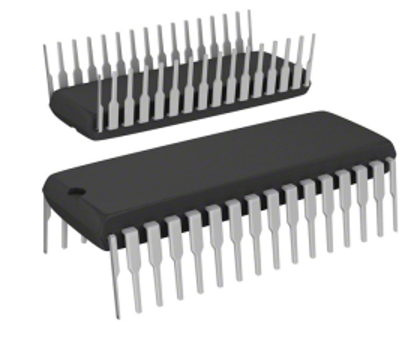
Static random access memory (SRAM) chips are dual-transistor memory cells that require a constant supply of power in order to retain their content. Common applications for SRAM memory chips include system caches and video memory.
Each SRAM bit is a flip-flop circuit made of cross-coupled inverters. The activation of transistors controls the flow of current from one side to the other. The transistors are connected so that only one transistor is in or out at any time.
When power is received, all SRAM cells are in a logical state of 1 (ON). Subsequent data writing changes some of the cells to a logical stage of 0 (OFF). This state is maintained until the next write operation, or when power is removed.
Because they use multiple transistors, SRAM memory chips are more expensive and require more power than DRAM memory chips; however, because they do not need to be constantly refreshed, SRAM memory chips are faster and more reliable.
Specifications
Density is the capacity of the chip in bits.
The number of words equals the number of rows, each of which stores a memory word and connects to a word line for addressing purposes.
The bits per word are the number of columns, each of which connects to a sense/write circuit.
Supply voltages range from - 5 V to 5 V and include many intermediate voltages.
Measured in nanoseconds (ns), access time indicates the speed of memory and represents a cycle that begins when the central processing unit (CPU) sends a request to memory and ends when the CPU receives the data requested.
Cycle time is the time required to both perform a single read or write operation and reset the internal circuitry so another operation can begin.
Data retention voltage and data retention current are, respectively, the minimum voltage and minimum current that SRAM memory cells must maintain in order to preserve stored data.
Measured in hertz (Hz), data rate is the number of bits per second that can be moved internally.
Logic Families
Transistor-transistor logic (TTL) and related technologies such as Fairchild advanced Schottky TTL (FAST) use transistors as digital switches. By contrast, emitter coupled logic (ECL) uses transistors to steer current through gates that compute logical functions.
Another logic family, complementary metal-oxide semiconductor (CMOS) uses a combination of p-type and n-type metal-oxide-semiconductor field effect transistors (MOSFET) to implement logic gates and other digital circuits.
- Cross-bar switch technology (CBT)
- Logic families for SRAM memory chips include:Gallium arsenide (GaAs)
- Integrated injection logic (I2L)
- Silicon on sapphire (SOS)
- Gunning with transceiver logic (GTL)
- Gunning with transceiver logic plus (GTLP)
IC Package Types
SRAM memory chips are available in a variety of IC package types and with different numbers of pins. Basic IC package types for SRAM memory chips include:
- Ball grid array (BGA) — Variants include plastic-ball grid array (PBGA) and tape-ball grid array (TBGA).
- Quad flat package (QFP) — Variants include low-profile quad flat package (LQFP) and thin quad flat package (TQFP).
- Dual in-line package (DIP) — Variants include ceramic (CDIP) and plastic (PDIP).
- Single in-line package (SIP)
- Small outline package (SOP)
- Thin small outline package (TSOP)
- Shrink small outline package (SSOP)
Standards
MIL-M-38510/245 — Microcircuits, Digital, CMOS, 4096 Bit, Static Random Access Memory (SRAM), Bulk Silicon And Silicon On Sapphire
MIL-M-38510/292 — Microcircuits, Digital, CMOS, 65,536-Bit Static Random Access Memory (SRAM) Monolithic Silicon
SRAM Memory FAQs
What are the differences between SRAM and DRAM?
SRAM: Does not need to be refreshed. This characteristic makes SRAM faster and more reliable as it retains data as long as power is supplied.
DRAM: Requires constant refreshing because the capacitors used in its structure lose charge over time. This refreshing process can slow down the memory access speed.
SRAM: Generally faster than DRAM because it does not require the time necessary to refresh each bit.
DRAM: Slower compared to SRAM due to the need for periodic refreshing.
SRAM: Often used in applications where speed is critical, such as in cache memory for CPUs and high-speed networking devices.
DRAM: Commonly used in main memory for computers and other devices where large memory capacity is required.
Structure:
SRAM: Utilizes a grid-like configuration with transistor-capacitor pairs at each intersection, which allows for faster access to data.
DRAM: Also uses a grid-like configuration but relies on capacitors that need refreshing, which impacts speed.
How does the cost of SRAM and DRAM affect their usage in different applications?
SRAM is more expensive to produce than DRAM. This higher cost is due to its complex structure, which typically involves more transistors per bit of memory.
DRAM is less expensive and more commonly used in applications where large amounts of memory are needed.
Due to its higher cost, SRAM is typically used in applications where speed and reliability are critical, such as in cache memory for CPUs and high-speed networking devices. Its static nature, which allows it to retain data as long as power is supplied, makes it suitable for these high-performance applications.
The lower cost of DRAM makes it ideal for use in main memory for computers and other devices where large memory capacity is required. Although slower than SRAM due to the need for periodic refreshing, DRAM's affordability and capacity make it a practical choice for general-purpose memory needs.
What is the technical structure of SRAM and DRAM?
SRAM uses a grid-like configuration with transistor-capacitor pairs at each intersection of the grid. This structure allows for fast access to data because it does not require refreshing.
Unlike DRAM, SRAM retains data as long as power is supplied, which contributes to its speed and reliability.
SRAM is faster than DRAM because it does not need to refresh each bit of data.
SRAM is often used in applications where speed is critical, such as in cache memory for CPUs and high-speed networking devices.
DRAM also uses a grid-like configuration but relies on capacitors that need refreshing. The capacitors lose their charge over time, necessitating constant refreshing to retain data.
This refreshing process involves interrogating the two lines that intersect at a specific point on the grid to read or write data.
DRAM is slower compared to SRAM due to the need for periodic refreshing.
It is less expensive and more commonly used in applications where large amounts of memory are needed.
DRAM is typically used in main memory for computers and other devices where large memory capacity is required.
These structural differences between SRAM and DRAM influence their respective applications, with SRAM being favored for speed-critical tasks and DRAM for cost-effective, high-capacity memory solutions.
What are some applications of SRAM in modern technology?
SRAM is commonly used as cache memory in CPUs. Its fast access times make it ideal for storing frequently accessed data, which helps improve the overall speed and efficiency of the processor.
In networking devices such as routers and switches, SRAM is used to store routing tables and other critical data that require quick access. This ensures efficient data handling and high-speed network performance.
SRAM is also used in environments where reliability is crucial, such as in aerospace and military applications. Its ability to retain data without the need for refreshing makes it suitable for these demanding conditions.
Many embedded systems, which require fast and reliable memory, utilize SRAM. This includes applications in automotive electronics, industrial control systems, and consumer electronics.
What is the role of SRAM in CPU cache memory?
SRAM is used in CPU cache memory because it is faster than DRAM. This speed is essential for cache memory, which stores frequently accessed data to improve the overall speed and efficiency of the processor. The fast access times of SRAM allow the CPU to retrieve data quickly, reducing the time it takes to execute instructions.
Unlike DRAM, SRAM does not need to be refreshed, which means it can provide quicker access to data without the delay associated with refreshing. This characteristic makes SRAM particularly suitable for cache memory, where rapid data retrieval is critical.
The static nature of SRAM also contributes to its reliability, as it retains data as long as power is supplied. This reliability is important in CPU cache memory, where data integrity is crucial for maintaining system performance and stability.
Although SRAM is more expensive to produce than DRAM, its performance benefits justify its use in CPU cache memory, where speed and reliability are prioritized over cost.
These attributes make SRAM an ideal choice for CPU cache memory, enhancing the processor's ability to handle tasks efficiently and effectively.
How does SRAM's static nature impact its performance in harsh environments?
SRAM does not require refreshing to retain data, unlike DRAM. This characteristic makes it more reliable in environments where a constant power supply might be challenging or where the system needs to maintain data integrity without frequent refreshing cycles.
The absence of a need for refreshing allows SRAM to access data more quickly, which is crucial in harsh environments where rapid data retrieval can be necessary for real-time processing and decision-making.
SRAM's ability to maintain data integrity without refreshing makes it suitable for applications in aerospace, military, and other industries where environmental conditions can be extreme and reliability is paramount.
These attributes make SRAM an ideal choice for applications in harsh environments, where its static nature ensures both speed and reliability, contributing to the overall performance and stability of the systems in which it is used.
SRAM Memory Media Gallery
References
Electronics360—A Crash Course in Computer Storage
Electronics360—Infineon unveils new harsh environment SRAM
Image Credits: