|
 PREFACE
 TABLE OF CONTENTS
 Chapter 1 - The Physics of Optical Components
1THE PHYSICS OF OPTICAL COMPONENTS1.1 INTRODUCTIONThe study of optical components requires knowledge of two disciplines, the physics of light and the physics of matter (mostly solid-state). Not to underestimate them, other disciplines such as metallurgy, chemistry, and crystallography are equally critical, but for the purpose of this book they are of secondary importance. Here we focus on that part of the physics of light and matter that helps one to understand how optical components work and what their issues are so that we can better appreciate how optical communications systems and networks are built, and how they can be built better, more efficiently, and at lower cost. The study of light is not new. In antiquity, light intrigued many cultures and religions, and at least one ancient religion worshiped light. However, some ancient scientists realized that although light had wonderful and unexplained properties, particularly as it passed through colorful crystals, these properties were not caused by divine intervention, but they were real and therefore they could be scientifically explained. This curiosity finally demystified the properties of light. Perhaps the mythological story of Prometheus is an attempt to convey in lay language the message that light is for people to use and understand. Once light was demystified, people used it in a number of applications, including the earliest optical communications network, which was constructed with light towers and used torches to signal a message from one tower to another (as Aeschylus wrote in his play Agamemnon). This optical network proved effective but vulnerable to interception, and Aeneas Takitos (a 4th c. B.C. military scientist from the town of Stymphalos) developed encoding techniques to transmit coded optical messages securely. The applications with light continued, and although today ancient applications sound trivial and elementary, at the time they were considered marvelous and state-of-the-art, exactly as our state-of-the-art achievements will be considered by future generations. In that regard, today is yesterday's future, and today is tomorrow's past. In the pursuit of explaining the properties of light, scientists discovered that both visible and invisible light truly consist of a continuum of components and many scientists tried to decompose it. Of course, nature did it in a natural way when light passed through a prismatic crystal. From this research effort, it was discovered that even the chlorine yellow line can be split into two lines by using a strong magnetic field. Soon it was proven that light was electromagnetic energy, but it also was discovered that light consists of quantized particles called photons. This discovery raised many eyebrows and created some animosity. Similarly, the propagation properties of light in transparent materials and in optical waveguides were studied. And this is history. Today many interesting materials have been developed, and glass-fiber is the chosen transmission medium for high-speed, high-reliability, and long-distance terrestrial and submarine communications. Currently, bit rates at 40 Gbps are used in a single fiber. With dense wavelength division multiplexing (DWDM), the aggregate bandwidth has exceeded one terabit per second. DWDM systems with 160 wavelengths have been announced, and 1000 wavelengths have been on the experimenter's workbench for some time. What does this mean? A 40-wavelength DWDM system at 40 Gbps per wavelength has an aggregate bandwidth of 1.6 Tbps, a bandwidth that can transport in a single fiber the contents of about 45,000 volumes of an encyclopedia in 1 second.
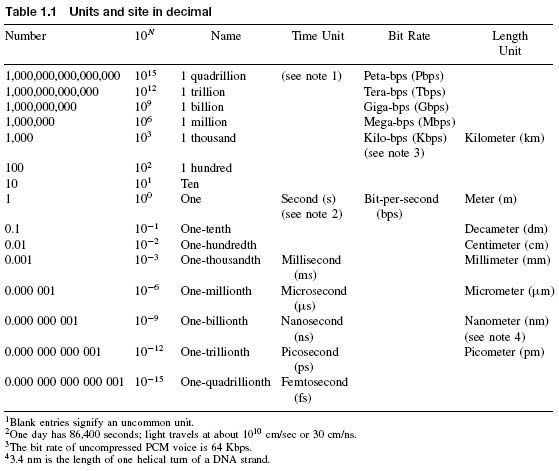
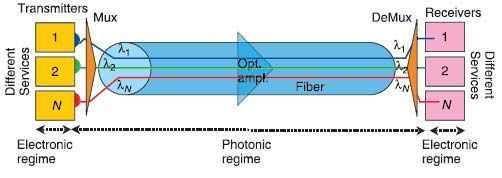
If a file of 1 terabit was transmitted using a 56-Kbps modem, it would take about 7 months (i.e., without interruption); at 40 Gbps it would take just 25 seconds! Denser DWDM systems are currently a trend that increases not only both the number of wavelength density per fiber and the aggregate bit rate, but also the length of fiber without signal amplification (Fig. 1.1). Certain numbers mentioned in this book may seem very small or very large. Table 1.1 puts into perspective what these number mean, such as a picosecond (ps) or a terabit per second (Tbps):
Figure 1.1 A conceptual DWDM path with many wavelength-channels in the same fiber. |