|
 PREFACE
 TABLE OF CONTENTS
 Chapter 4.2 - DWDM Network Topologies-Review
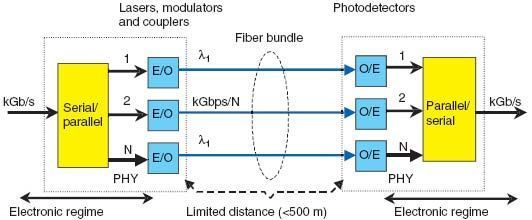
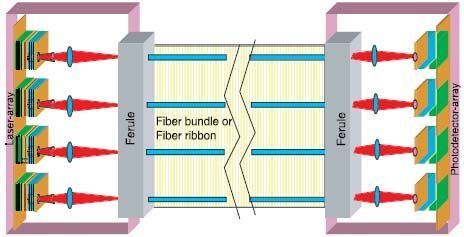
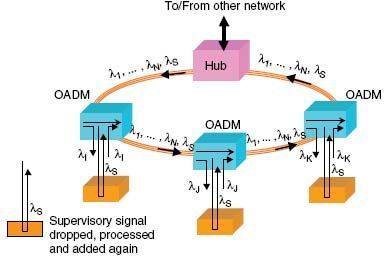
4.2 DWDM NETWORK TOPOLOGIES-REVIEWTo describe some aspects of DWDM system complexity, we must elaborate on some key network topologies. The most well known topologies are the point-to-point, the ring (single and dual), the fully connected mesh and star. In addition, there are subtopologies such as the ladder and point-to-point with add-drop. The performance of each network topology depends on many factors. Among them: number of nodes, elasticity, seamless evolution, maximum traffic capacity, service restoration capability, fault resiliency, real-time aspects of transported traffic, versatility of supported traffic types, reliability, bandwidth management efficiency, number of fiber links between nodes, maintainability, reconfigurability, scalability, economics, trends and market preference, and so on. The ring topology may currently be preferred only because of familiarization with the already embedded SONET/SDH ring network, and the mesh (fully connected) topology because of superior survivability. The point-to-point DWDM topology is a transport technology that enables aggregate traffic with few or many wavelengths over a single fiber (see Chapter 1, Figure 1.1). In this case and for short distances (a few kilometers), few wavelengths (16 to 40) at low bit rate each (1.25 Gb/s, 2.5 Gb/s and up to 10 Gb/s) and multimode fiber may be used. For long distances (hundreds of kilometers), many wavelengths (80-160 or more) at high bit rate each (10-40 Gb/s or higher) each are multiplexed in a fiber. Optical add-drop multiplexing typically is not an option and because of the insertion loss, fiber loss, and other phenomena that degrade the optical signal (see Chapter 2) amplification, equalization, and pulse-shapers are used. Optical amplification (depending on fiber and amplifiers) is every 60 to 80 kilometers, as is dispersion compensation. In addition, supervisory signals that transport data for performance, control, provisioning, maintenance, and administration for each channel may be in-band (embedded in the optical channel) or out of band (using a separate channel). Another point-to-point application but for very short-distance (up to a few hundred meters) converts a serial bit stream in parallel and transmits over a (parallel) fiber bundle at a rate per fiber kGbps/N, where k is the serial bit rate and N is the number of fibers in the bundle (Fig. 4.1). Parallel transport takes advantage of low cost when laser-arrays and photodetectorarrays are integrated on the same substrate. In this case, even though a moderate bit rate per laser is used, a high aggregate bit rate is achieved (Fig. 4.2). We examine the parallel transport and other derivatives more in subsequent sections of this chapter (see parallel λ-bus). The ring topology comes in many flavors, depending on size (circumference) of the ring, the number of nodes it supports and the types of services. It may be a small ring (a few kilometers circumference) that supports up to 16 passive OADM nodes (Fig. 4.3). In this case, the number of wavelengths is at minimum 16 (one per OADM node and perhaps some more for protection), the bit rate per wavelength may be up to 10 Gb/s, and there is an additional supervisory channel shared by all nodes at a bit rate between 2 and 10 or perhaps 100 Mb/s. Such rings have one of the ring nodes designated as a hub. The hub in this case performs some additional duties such as flow control and management; it provides connectivity to other networks and connectivity from one node to another on the same ring, and it sources and terminates the supervisory channel. In some cases, the hub receives a wavelength from a node and converts it to another wavelength. This is also known as broadcast and select.
Figure 4.1 Parallel transport of high bandwidth over short distances.
Figure 4.2 Laser and photodetector arrays make the serial to parallel transmission economically feasible in many short-haul applications.
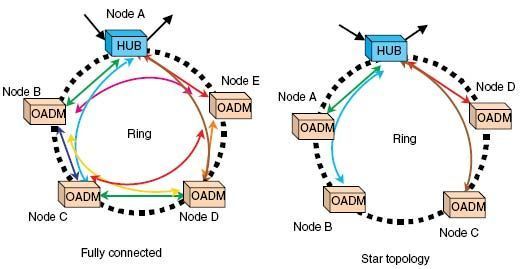
Figure 4.3 A ring topology with add-drop multiplexers and supervisory channel. The ring also may be large (several tens or even hundreds of kilometers in circumference) supporting several (32 or more) active OADM nodes, each dropping and adding one or more wavelengths. In this case, the number of wavelengths is at minimum 32 and at maximum NX32 (N per OADM node). In such case, wavelengths may be remotely programmable; the ring is protected (i.e., this is a dual ring); the signal requires amplification, equalization, and pulse-shaping; and there are one or more supervisory channels that are either shared by all nodes, or each node has its own dedicated supervisory channel, or some other strategy. In general, the supervisory channel carries performance, control, provisioning, maintenance, and administration data to and from each node. Here, four supervisory channel strategies are described, addressable packets, shared packets, channelized packets, and hybrid packets. In addressable packets, the supervisory data are mapped in a packet addressing a node on the ring. Nodes read the destination address in each incoming packet. The node that is addressed terminates it and sources a new packet which is added on to the ring (see Fig. 4.3). Packets not addressed to a node are not terminated; they are multiplexed into the main WDM stream heading to the next node. In shared packets, the packet has been partitioned into sections, and each section corresponds only to a node. Thus, each node terminates its own section, buffers the other sections unaltered, rewrites its own section, and re-sources the complete packet to the next node. Thus, all nodes may be addressed at once with the same packet minimizing latency. In the channelized case, each node has its own dedicated supervisory channel (wavelength); the wavelength is dropped, terminated, re-sourced, and multiplexed in the main DWDM stream. This is the fastest method to communicate with a node, but it uses spectral resources (wavelength) for each node. However, it may be applicable in high-performance systems where real-time supervisory data at high rate is very critical. In the hybrid case, it may be any two of the above methods combined. For instance, it may be addressable and shared, addressable and channelized, or shared and channelized. Which of the preceding supervisory strategies is most suitable depends on the type of services supported, the performance parameters of the network, protocol efficiency, node complexity, and economics. A special case of a physical ring is that of a fully connected mesh topology or a star topology (Fig. 4.4). These cases result in different supervisory strategies. We have made reference to nodes based on terminology that stems from traditional communications networks. In data networks, the term node is replaced by the term router. For simplicity, it really does not matter which term is used, since modern DWDM networks transport a mix of traffic, TDM (DSn, SONET/SDH), ATM, and IP, thanks to convergence, transparency of service, and the evolving network. In DWDM applications, a router that provides IP connectivity; performs DSn or OC-n grooming, optical multiplexing, and optical cross-connection; and provides real-time quality of services (QoS) starts looking like a traditional node. Similarly, a traditional node that provides packet-like connectivity, with priority based on bandwidth availability, and service level agreement (SLA), starts looking like a traditional router. Therefore, although nodes and routers may differ conceptually, we do not discriminate between the two.
Figure 4.4 Mapping a fully connected mesh and a star topology onto a physical ring topology with add-drop multiplexers. |