|
 PREFACE
 TABLE OF CONTENTS
 Chapter 4.9.2 - Large Optical Cross-Connect Systems
4.9.2 Large Optical Cross-Connect Systems
Large (in fabric capacity) optical cross-connect systems consist of nodes of a geographically large mesh network, or backbone.
Backbone networks are intelligent optical networks (ION) that consist of relatively few but very large bandwidth nodes that are interconnected in a mesh topology (in fact, what makes the network intelligent are its nodes, protocols, and network management). Each node has a very large optical cross-connecting fabric (larger than 1,000 x 1,000 wavelengths); the number of wavelengths per fiber ranges from 80 to 160 (or more); the bit rate per optical channel is 10 Gb/s or 40 Gb/s (projected to 160 Gb/s); and each system may terminate several fibers, depending on switching fabric capacity and network survivability strategy. Large optical cross-connect systems transport aggregated traffic from Metro and other networks from node to node in the backbone.

Figure 4.49 Point-to-point linear optical add-drop multiplexer topology allows traffic to be dropped and added between two end points of a path.
In mesh topology where links between nodes become long (hundreds of kilometers), they appear to have a localized point-to-point topology (see Fig. 4.5, upper right section). In transoceanic applications, the topology is predominantly point-to-point, possibly with a few add-drops. However, submarine DWDM networks may also have a ring or star topology to provide service to a cluster of islands. Realistically, long-haul and backbone networks have a hybrid topology where add-drops are used for traffic distribution, service restoration, and disaster avoidance.
The protection strategy of backbone mesh networks depends on large optical cross-connect (OXC) systems with fast rerouting algorithms. When traffic from a fiber is lost due to a severe fault, the fault is detected and part of the remedial action is to quickly find alternate routes for interrupted service.
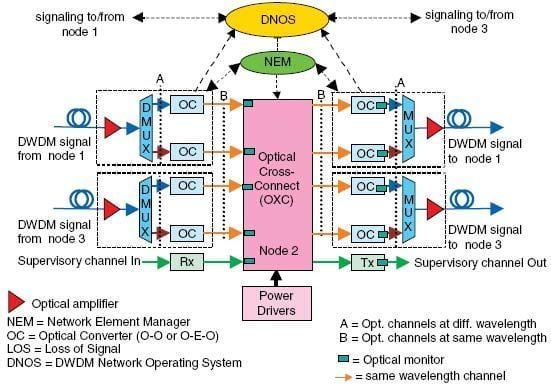
Figure 4.50 A typical DWDM optical cross-connect architecture based on current technology.
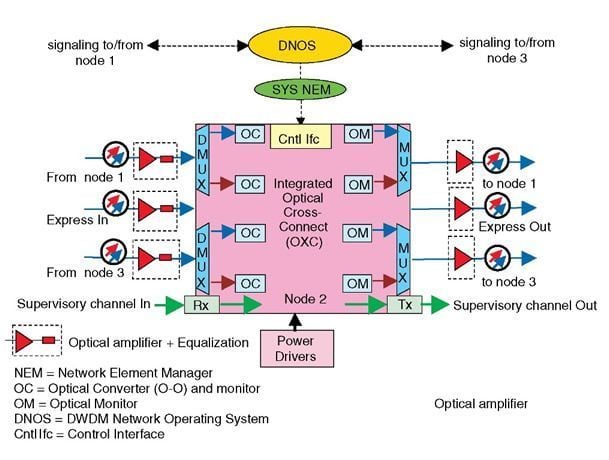
Figure 4.51 An advanced DWDM optical cross-connect architecture.
Although large electronic cross-connect (EXC) systems with optical inputs/outputs (I/O) and SONET rates have been in use for several years, all-optical cross-connect (OXC) systems surpass them on many counts. OXCs are proving themselves on technology, performance, power consumption, and physical size. As an example, the physical size of large OXCs compared with that of EXCs is twice as small (6 to 7 bays vs. 10 to 14), and the power consumption of large OXCs compared with EXCs is at least three to four times lower (10 to 14 kW vs. 40 to 45 kW). Figure 4.50 depicts a possible system architecture based on current optical technology, and Figure 4.51 the same system with advanced photonic technology. In addition, they have all the features of an EXC and many desirable features that EXCs do not have, such as (the ones in bold are specific to OXCs):
- optical traffic transparency
- protocol transparency by virtue of DWDM
- capacity
- managed wavelength services (in conjunction with intelligent network management)
- bulk amplification of many channels by virtue of DWDM
- protection
- service restoration at different grades: platinum (less than 50 ms, 1 + 1 optical protection), gold (1-2 min, optical channel shared protection ring – OCh/Spring), silver (within day or faster with preplanned restoration routes), and bronze (pre-emptable service layer restoration)
- service restoration by virtue of DWDM
- bit rate independence (2.5, 10, 40 Gb/s) by virtue of DWDM
- protocol independence by virtue of DWDM
- compliance with standards related to signal input/output (ITU-T, Telcordia, etc.)
- compliance with electrical and physical design standards (NEBS, MEBS, ETSI, UL, CE, etc.)
- scalability by virtue of DWDM
- reliability
- wavelength management by virtue of DWDM
- high density (single stage) cross-connect fabric (more than 1,000 x 1,000)
- cross-connect fabric transparent to payload format and bit rate
- redundancy
- 1 + 1 protection for restoration
- new signal format with FEC
- security
- optical 2R, and 3R to be available soon
Currently, the only function OXCs do not perform is overhead termination and switching on the packet or frame granularity as this requires optical synchronization on the bit/byte level, which has not been implemented yet, although optical solutions have been proposed.