|
 PREFACE
 TABLE OF CONTENTS
 Chapter 4.10 - Protected and Unprotected Systems
4.10 PROTECTED AND UNPROTECTED SYSTEMSIn Section 4.9, we described protection in many occasions. We have described how high bandwidth capacity long-haul and large Metro networks are using the 1 + 1 protection scheme, whereas networks of lesser bandwidth capacity use 1:1 or even 1:N protection. 1 + 1 protection (see Fig. 4.42) sends the same traffic simultaneously over two separate paths. It is up to the receiving end, based on transmission performance metrics, to decide which of the two paths will be accepted. As performance metrics on the selected path fall short, the receiving end autonomously switches to the other path. Typical performance metrics are BER before and after FEC, signal power level, loss of signal, and others. This protection scheme is highly reliable and fast, but it requires twice the network resources. 1:1 protection has two possible paths between source and destination. However, the source determines which of the two paths will be used for traffic, and it is up to the destination to determine the degradation of performance metrics, in which case it communicates over a separate channel with the source to initiate a path switch. This protection scheme is slower and requires protocol coordination and execution between source and destination, but it does not commit twice the network resources. In addition to protection on the network level, there is protection on the system level. For example, 1 + 1 protection of the switching fabric implies that there are two units that in parallel pass traffic but only the output of one is selected, based on performance parameters, such as optical power level and wavelength accuracy. When the working unit degrades, the output selector autonomously switches to the other unit; similarly, with the system or shelf controller. 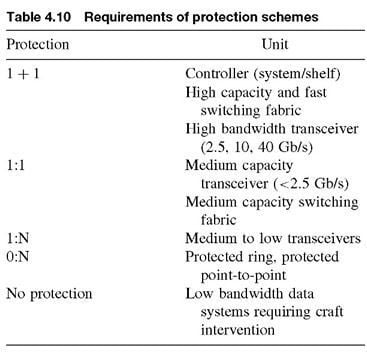 1:N protection on the system level is used predominantly on the input-output ports. In this case, although the system requires N working ports, an additional protection port is included. As soon as any of the N ports degrades or has a fault, the protection port replaces it automatically (under system control). The 1:N protection scheme implies that all N ports are of the same type. However, when the N ports are in groups of k types, then k protection ports may be included (one per group), in which case it is termed k:N. When k = 0, the 0:N implies that there is no protection on the system level; however, this does not imply that there is no protection against line fault. That is, if one of the trunks is at fault, for example, then there is a mechanism that switches to another protection line (as already discussed in the case of ring protection). The applicability of the various protection schemes on the system level are listed in Table 4.10. |