|
 PREFACE
 TABLE OF CONTENTS
 Chapter 4.3 - DWDM Systems and Network Layers
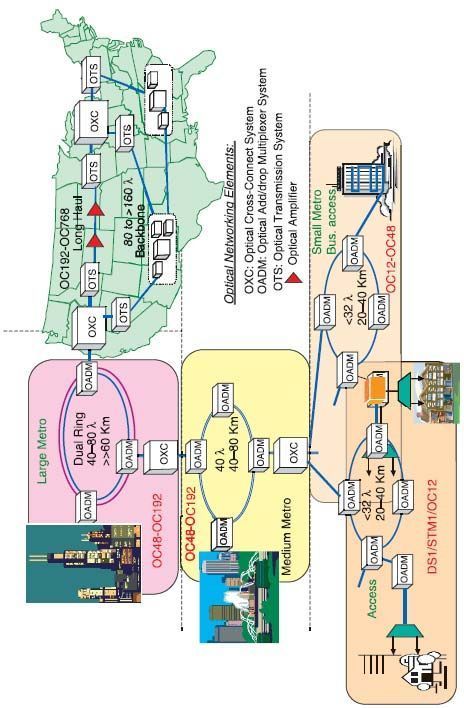
4.3 DWDM SYSTEMS AND NETWORK LAYERSDWDM systems are applicable to many network types and network layers. They are applicable to long-haul optical transport networks (OTN), backbone networks, large Metropolitan (Metro) networks, medium and small local area networks and access networks that eventually connect with the home or office (FTTH, FTTC, etc.). Therefore, DWDM systems, depending on applicability, have different design and specification challenges. Figure 4.5 captures the layered networks and illustrates the applicability of each, indicating the level of complexity in terms of bit rates, wavelength capacity, and physical size. 4.3.1 DWDM and StandardsIn WDM networks, depending on the number of nodes and optical channel (wavelength) specifications, a system is termed DWDM (dense WDM) if many wavelengths are used (above 40 and based on the ITU-T grid) and CWDM (coarse WDM) if few wavelengths are used (8-32); the number of channels is related to channel spacing, which along with other factors (power of laser and SMF or MMF), impact performance and cost. DWDM technology is evolving and therefore issues associated with it are also evolving. Standards bodies, such as ITU-T, are issuing recommendations (e.g., G.709 for optical transport networks) and are working toward drafting new ones. In the meantime, manufacturers offer systems with semiprivate solutions to meet market demands, which can be retrofitted to meet forthcoming standards. As a consequence, network management, as well as reliability, switching time, latency, and quality of service, may differ from vendor to vendor. Some manufacturers also use a supervisory channel for OAM&P (typically at 1,310 nm or at about 1,500 nm), but wavelength, bit rate, and protocol may not be common. Dynamic wavelength assignment and wavelength protection are issues awaiting solutions. Current systems support fixed wavelength assignment per node, but automatic and remote provisioning is highly desirable. Finally, degradation or fault detection, localization, and remedial actions, although defined for optical networks with a single wavelength per fiber, have not been addressed in DWDM networks. Fault detection and localization in DWDM systems and networks require specialized monitoring devices and critical diagnostic functions at different levels that affect the quality of signal and service. These are on the component, module, and unit levels. Detected degradations or failures generate messages and/or alarm signals, based on which correlation may provide an early warning of an upcoming critical failure. Then, fault-case scenarios activate testing and fast remedial action so that service is provided virtually uninterrupted.
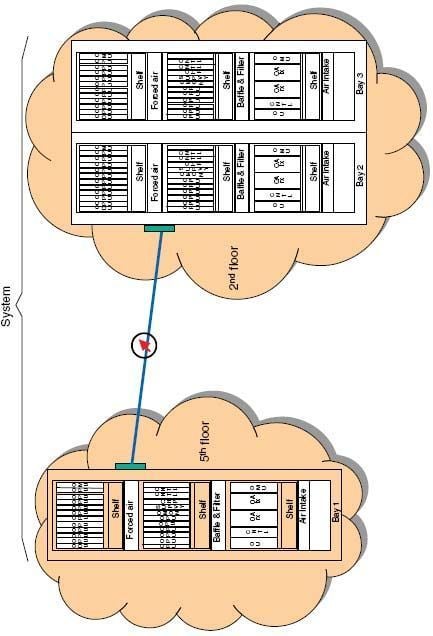
Figure 4.5 DWDM systems are applicable in all network layers; access, Metro, large Metro, and long haul/backbone optical transport network. As many standards are still on the drafting board, the reader is encouraged to consult relevant standards documents and their amendments, if any, before embarking on actual engineering and design work. 4.3.2 Domains or FunctionsDWDM systems consist of communication nodes that receive a multiplicity of continuous and synchronous data streams of multiplexed optical channels, which are not synchronized; they terminate, pass through, or add-drop channels, as described in Chapter 1. Such systems consist of well-established functions, which are typically referred to as domains such as transmitting and receiving, amplification, timing, provisioning, signal conditioning, cross-connectivity, multiplexing and demultiplexing. 4.3.3 System Partitioning and RemotingThe aforementioned functions or domains may not represent physical entities. Physical entities or units consist of printed circuit boards that may contain one or more functions, such as, for example, optical receiving and transmitting, timing, power amplification, cross-connecting, and so on. In general, the partitioning and consolidation of functions on physical entities does not have strict rules but it is a logical outcome based on cost, power, heat dissipation, physical dimensions, component size, and backplane interconnectivity. Thus, partitioning may culminate in one or many physical units that necessitate grouping (collocation of several units with similar functionality). For large systems the physical partitioning may be so complex that units are organized into subgroups, whereby each subgroup has its own power supply, timing unit, and controller comprising a shelf. Then, several shelves may comprise a bay, and several bays may comprise the "system" or node (Fig. 4.6). In large systems, a shelf may house the main system controller, the optical amplifiers, or the cross-connecting fabric.
Figure 4.6 Large optical systems consist of units, shelves and bays (unit arrangement is imaginary).
Figure 4.7 The concept of "remoting" a large multibay system. In certain cases, because of floor space limitation, it is not uncommon to have bays of a system located on different parts of a floor or in different floors of a building, thus requiring point-to-point interconnectivity that may be up to 1 kilometer long (but preferably under 200 m); this practice is known as "remoting" (Fig. 4.7). When bays are adjacent to each other, interconnecting cables are on the order of a few meters, and the physical cable plant as well as the transmission driving capability and latency are manageable. Remoting, however, creates another challenge that requires different solutions, as described in Section 4.2 (see Fig. 4.2). |