Blowout and Well Control Handbook
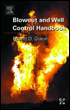
Providing the most up-to-date techniques and tools for blowout and well control, this comprehensive guide reviews specific situations along with detailed procedures to analyze alternatives and tackle problems.
 TABLE OF CONTENTS
 24 September
0600-0630 Service rig.
0630-2130 Drilling 12,855 feet to 13,126 feet for 271 feet.
2130-2200 Pick up and check for flow. Well flowing. Shut well in.
2200-2300 Pump 35 barrels down drillpipe. Unable to fill drillpipe.
2300-2330 Observe well. 1000 psi on casing. 0 psi on drillpipe.
2330-0030 Pump 170 barrels down drillpipe using Barrel In-Barrel Out Method. Could not fill drillpipe. 0 psi on drillpipe. 1200 psi on casing at chokepanel. Shut pump off. Check gauge on choke manifold. Casing pressure 4000 psi at choke manifold. Choke panel gauge pegged at 1200 psi. Well out of control.
This drilling report was taken from a recent blowout in the South Texas Gulf Coast. All of the men on the rig had been to well control school and were Minerals Management Service (MMS) certified. After the kick, it was decided to displace the influx using the Barrel In-Barrel Out Method. As a result, control was lost completely and an underground blowout followed.
Prior to 1960, the most common method of well control was known as the Constant Pit Level Method or the Barrel In-Barrel Out Method. However, it was realized that if the influx was anything other than water, this method would be catastrophic. Consequently, classical pressure control procedures were developed. It is incredible that even today there are those in the field who continue to use the older, antiquated methods.
Ironically, there are instances when these methods are appropriate and the classical methods are not. It is equally...