Blowout and Well Control Handbook
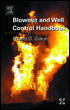
Providing the most up-to-date techniques and tools for blowout and well control, this comprehensive guide reviews specific situations along with detailed procedures to analyze alternatives and tackle problems.
 TABLE OF CONTENTS
 22 June
Trip out of the hole. Well began flowing. Trip in the hole with the bottomhole assembly. Gained 60bbls. Circulated the hole. Pressure continued to increase. Shut in well with 3000 psi. Drillpipe started coming through the rotary table. Opened choke, closed pipe rams above tool joint, and closed choke. Total gain was 140 barrels. Attempt to close safety valve without success. Open choke, close safety valve, close choke. Had 200 barrel total gain. Rigged up snubbing unit.
14 July
Began snubbing in the hole.
15 July
Continued snubbing to 4122 feet. Circulated 18.5-ppg mud. Surface pressure is 3700 psi.
16 July
Snubbed to 8870 feet. Began to circulate 18.5-ppg mud. Surface pressure increased to 5300 psi on casing. Mud in is 540 bbls versus mud out of 780 bbls. Increased pump rate from 3bpm to 6bpm. Drillpipe pressure increased to 6700 psi. Hammer union on rig floor washed out. Unable to close safety valves on rig floor due to excessive pressure and flow. Hydrogen sulfide monitors sounded. Ignited rig with flare gun.
The drilling report above is a good illustration of a disaster resulting from complications during tripping operations at a well that was under control only a few hours prior to the trip. It must be reasoned that any well that is tripped is under control when the bit leaves bottom. Therefore, operations subsequent to the beginning of the trip precipitate the well control problem. As is often the case, due to operations subsequent to the...