Blowout and Well Control Handbook

Providing the most up-to-date techniques and tools for blowout and well control, this comprehensive guide reviews specific situations along with detailed procedures to analyze alternatives and tackle problems.
 TABLE OF CONTENTS
 Frictional pressure losses inside the drill string are usually measured while frictional pressure losses in the annulus in conventional operations are usually ignored. However, in any kill operation, well-site personnel should have the means and ability to calculate the circulating pressure losses.
For laminar flow in the annulus, the frictional pressure loss is given by Equation 4.11 for the Power Law Fluid Model:

For laminar flow inside pipe, the frictional pressure loss is given by Equation 4.12:

For turbulent flow in the annulus, the frictional pressure loss is given by Equation 4.13:

For turbulent flow inside pipe, the frictional pressure loss is given by Equation 4.14:

For flow through the bit, the pressure loss is given by Equation 4.15:

Where:
P bit = Bit pressure losses, psi
P fla = Laminar annular losses, psi
P fta = Turbulent annular losses, psi
P fli = Laminar losses inside pipe, psi
P fti = Turbulent losses inside pipe, psi
 = Average velocity, fpm
D h = Hole diameter, inches
D p = Pipe outside diameter, inches
D i = Pipe inside diameter, inches
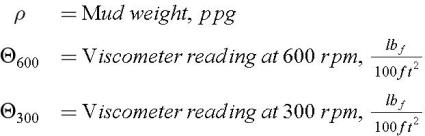

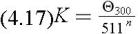
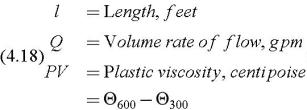

Flow inside the drill string is usually turbulent while flow in the annulus is normally laminar. When the flow regime is now known, make the calculations assuming both flow regimes. The calculation resulting in the greater value for frictional pressure loss is correct and defines the flow regime.
Example 4.7 illustrates a calculation.
Given:
Wellbore...