Blowout and Well Control Handbook
Providing the most up-to-date techniques and tools for blowout and well control, this comprehensive guide reviews specific situations along with detailed procedures to analyze alternatives and tackle problems.
 TABLE OF CONTENTS
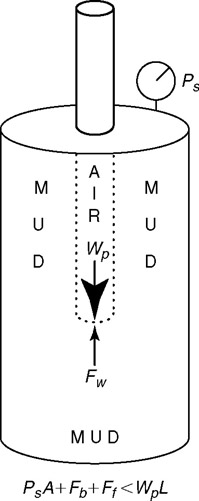
 Snubbing is the process of running or pulling tubing, drillpipe, or other tubulars in the presence of sufficient surface pressure to cause the tubular to be forced out of the hole. That is, in snubbing the force due to formation pressure's acting to eject the tubular exceeds the buoyed weight of the tubular. As illustrated in Figure 6.1, the well force, F w, is greater than the weight of the pipe. The well force, F w, is a combination of the pressure force, buoyant force, and friction force.
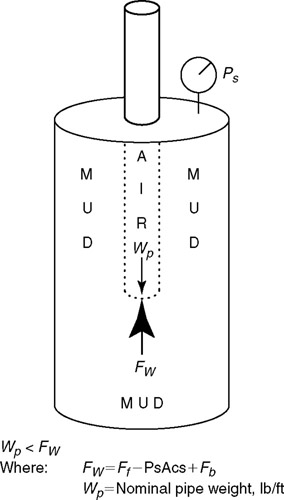
Stripping is similar to snubbing in that the tubular is being run into or pulled out of the hole under pressure; however, in stripping operations the force resulting from the surface pressure is insufficient to overcome the weight of the string and force the tubular out of the hole (Figure 6.2).
Snubbing or stripping operations through rams can be performed at any pressure. Snubbing or stripping operations through a good quality annular preventer are generally limited to pressures less than 2000 psi. Operations conducted through a stripper rubber or rotating head should be limited to pressures less than 250 psi. Although slower, ram-to-ram is the safest procedure for conducting operations under pressure.
Some of the more common snubbing applications are as follows:
Tripping tubulars under pressure
Pressure control/well-killing operations
Fishing, milling, or drilling under pressure
Completion operations under pressure
There are some significant advantages to snubbing operations. Snubbing may be the only option...