Blowout and Well Control Handbook

Providing the most up-to-date techniques and tools for blowout and well control, this comprehensive guide reviews specific situations along with detailed procedures to analyze alternatives and tackle problems.
 TABLE OF CONTENTS
 When a washout occurs in the drill string, a loss in drillpipe pressure will be observed with no corresponding loss in annulus pressure. The only alternative is to shut in the well and analyze the problem. If the Driller's Method is being used, the analysis is simplified. As illustrated in Figure 4.13a, if the well is shut in and the influx is below the washout, the shut-in drillpipe pressure and the shut-in annulus pressure will be equal. Under these conditions, the U-Tube Model is not applicable and no classical procedure is appropriate.
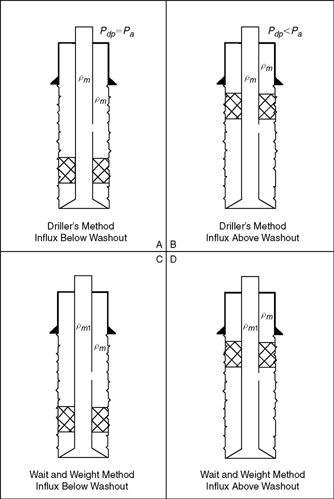
There are several alternatives. Probably the best general alternative is to permit the influx to migrate to the surface pursuant to the prior discussions and, once the influx has reached the surface, circulate it out. Another alternative is to locate the washout, strip out to the washout, repair the bad joint or connection, strip in the hole to bottom, and resume the well control procedure.
If the Driller's Method is being utilized when the washout occurs, the well is shut in, and the influx is above the washout as illustrated in Figure 4.13b, the shut-in drillpipe pressure will be less than the shut-in annulus pressure. Under these conditions, the U-Tube Model is applicable and the influx can be circulated out by continuing the classical Driller's Method as outlined in Chapter 2.
The frictional pressure losses in the drill string have been altered and the circulating pressure at the kill speed which...