Blowout and Well Control Handbook

Providing the most up-to-date techniques and tools for blowout and well control, this comprehensive guide reviews specific situations along with detailed procedures to analyze alternatives and tackle problems.
 TABLE OF CONTENTS
 An underground blowout is defined as the flow of formation fluids from one zone to another. Most commonly, the underground blowout is characterized by a lack of pressure response on the annulus while pumping on the drillpipe or by a general lack of pressure response while pumping. The underground blowout can be most difficult, dangerous, and destructive. It can be difficult because the conditions are hidden and can evade analysis. Often, the pressures associated with an underground blowout are nominal, resulting in a false sense of security.
It can be dangerous because some associate danger with sight. In many instances there is no physical manifestation of the underground blowout. If a well is on fire or blowing out at the surface, it commands respect. However, if the same well is blowing out underground, it is more easily ignored. Since the underground blowout is not seen, it is often not properly respected.
If the flow is to a shallow formation (less than 3000 feet), there is a very real possibility the flow will fracture to the surface. This possibility is greater in young sediments such as those common to coastal areas and offshore.
At a location in Bolivia, the flow broached to the surface and created a crater more than 100 meters in diameter (Figure 8.1). At least one wellhead, a workover rig, mud tanks, and several pump trucks disappeared into the crater and were never recovered.
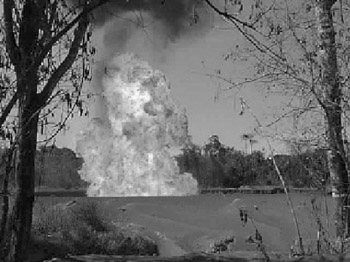
Shallow underground blowouts in offshore operations can be even more dangerous.