4.1 General Relationships
In this chapter, we will discuss what is known historically as "Kepler's problem." Succinctly stated, this problem is one of finding the state (position and velocity) of an object in orbit at a specified time t, given the state at some reference time t 0.
For example, let us assume that, at the reference (or initial condition) time, the object is not necessarily at its perifocal point. That is, we will assume the state at t 0 to be available in the following terms:
| a | = semimajor axis |
| e | = eccentricity |
| i | = inclination |
| ? | = right ascension of the ascending node |
| ? | = argument of perifocal point |
| ? | = true anomaly (not zero in the present discussion) |
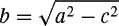
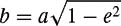
To fix ideas firmly, let us review what these terms signify. First, a and e specify the size and shape of the orbit as illustrated in Fig. 4.1. The semiminor axis b is related to the semimajor axis a by the relationship of
where
or
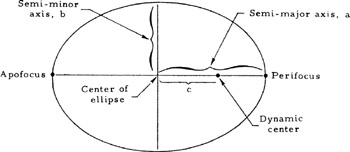 Figure 4.1: Size and shape of an orbit.
 Second, the orientation of the orbit is specified by i, ?, and ?, i.e., inclination, right ascension of the ascending node, and argument of perifocus, respectively, as illustrated in Fig. 4.2.
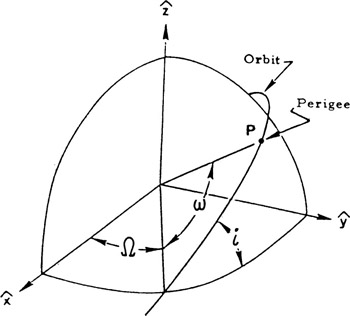 Figure 4.2: Orientation of an orbit.
 Third, the position of the object is specified by the sixth term, ?, true anomaly, which is measured in the orbit plane from the perifocal axis, as shown...


 TABLE OF CONTENTS