Orbital Mechanics, Third Edition

Newton's law of gravitation states that any two particles of mass m 1 and m 2, distance r apart, are attracted toward each other with a force
| (3.1) | |
where G is a universal constant called the gravitational constant. The value of G is (6.6726 0.0005) 10 ?11 m 3/kg-s 2(1 ?), which is known to about 1 part in 13,000. [1] The value of ? = GM e, on the other hand, where M e is the Earth mass, is known to a much higher accuracy, and is therefore used for astrodynamical calculation. Accurate measurement of the gravitational attraction between small masses is limited by the accuracy to which G is known.
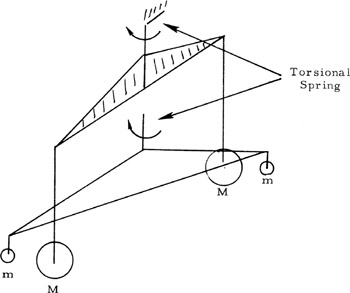
There are several laboratory techniques available for the determination of G. One of the most accurate experiments to determine G is the "time of swing method" of Heyl. This approach is illustrated in Fig. 3.1, where two large masses M and two small masses m are placed on coaxially suspended torsional springs.
When two balances are aligned in parallel, the period of oscillation is less than when they are aligned at right angles. In the former position, the gravitational attraction adds to the torsional spring whereas, in the latter position, the attraction subtracts from the spring. The periods are on the order of 0.5 h and can...