Orbital Mechanics, Third Edition

Chapter 11: Orbital Systems

11.1 Launch Window Considerations

Launch Azimuth

The launch of a satellite into an orbit with inclination i requires launching in an azimuth direction Az defined by the formula

(11.1)

where ? 0 is the launch site latitude. For a due east launch ( Az = 90 deg), i = ? 0, or the orbital inclination is equal to the launch site latitude. Differentiating Eq. (11.1) and solving for d i, one obtains

(11.2)

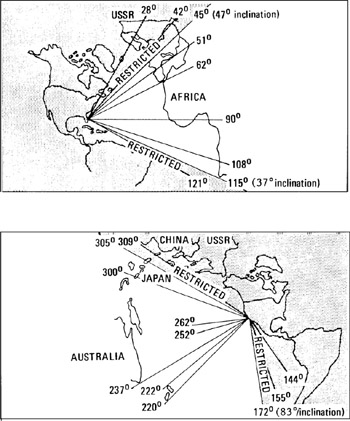
which shows the sensitivity of inclination error d i due to an error in azimuth d Az. For range safety reasons, the azimuth may be constrained between specified limits, as is shown in Fig. 11.1, for example.


Figure 11.1: Geographic launch constraints.

In-Plane or Out-of-Plane Ascent Using a Launch Azimuth Constrained to the Nominal Value

The most efficient launch is an in-plane launch ascent characterized by a wait on the ground until the launch site lies in the mission orbit plane, which is fixed in inertial space. No plane change maneuver is then required unless the orbit inclination is less than the launch site latitude or the launch azimuth constraint is such that a "dog-leg" maneuver is needed. A direct ascent to a parking or mission orbit may be made with or without a phasing orbit to place the satellite in a specified geographic location. The phasing problem where the parking and mission orbits are not coplanar may involve excessive waiting times, which can be somewhat reduced...

UNLIMITED FREE
ACCESS
TO THE WORLD'S BEST IDEAS

SUBMIT
Already a GlobalSpec user? Log in.

This is embarrasing...

An error occurred while processing the form. Please try again in a few minutes.

Customize Your GlobalSpec Experience

Category: GPS Chips and Modules
Finish!
Privacy Policy

This is embarrasing...

An error occurred while processing the form. Please try again in a few minutes.