This chapter provides a description of each of the perturbation forces and considers the actual applications to mission design and analysis of Earth satellite missions. The various perturbation forces are: Earth's oblateness and its triaxiality, the lunisolar gravitational attractions, the solar-radiation pressure, the Earth atmospheric drag, and the tidal friction effects. The interesting properties of orbits with critical inclination (Molniya orbit), sun-synchronous orbits, frozen orbits, and the long-term coupling between sun-moon attractions and Earth oblateness effects will be discussed.
10.1 Earth's Oblateness ( J 2) Effects
The principal effects of the J 2 zonal harmonic or Earth's oblateness are secular motions of the node ? and perigee ? of an orbit. The westward rotation of the orbit plane is illustrated in Fig. 10.1, where S denotes the longitude difference between two successive crossings of the equator.
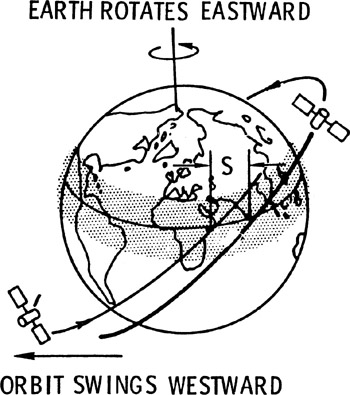 Figure 10.1: The gravitation pull of the Earth's equatorial bulge causes the orbital plane of an eastbound satellite to swing westward.
 The motion of the node ? occurs because of the added attraction of the Earth's equatorial bulge, which introduces a force component toward the equator. The resultant acceleration causes the satellite to reach the equator (node) short of the crossing point for a spherical Earth. The orbit thus regresses a delta node ( ? ?) each revolution. This effect may also be regarded as gyrodynamic precession due to a torque acting on the satellite angular momentum vector caused by the additional attraction of the Earth's equatorial...
Copyright American Institute of Aeronautics and Astronautics, Inc. 2002 under license agreement with Books24x7


 TABLE OF CONTENTS