5.1 Orbital Energy
Any analysis of orbital maneuvers, i.e., the transfer of a satellite from one orbit to another by means of a change in velocity, logically begins with the energy or vis-viva equation derived in Chapter 3 as
| (5.1) | 
|
where V is the magnitude of the orbital velocity at some point, r the magnitude of the radius from the focus to that point, a the semimajor axis of the orbit, and ? the gravitational constant of the attracting body. Figure 5.1 illustrates r, V, and a.
 Figure 5.1: Conservation of energy relates r, V, and a.
 Equation (5.1) can be rearranged as
| (5.2) | 
|
where it is evident that
Note that total energy/satellite mass is dependent only on a.As a increases, energy increases.
Figure 5.2 illustrates total energy/satellite mass as a function of orbit period,
| (5.3) | 
|
so that the figure is really a plot of ? ?/2 a vs (2 ?/ ? ?) a 3/2. The lowest energy and period point corresponds to a Space Shuttle parking orbit, a circular orbit at an altitude of 280 km. Points corresponding to other interesting orbits are labeled on the curve.
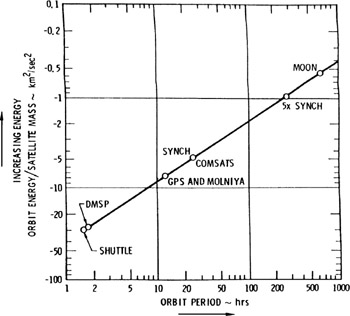 Figure 5.2: Specific orbital energy as a function of orbit period.
 Note that many of the orbits are circular for which a = r. When substituted into Eq. (5.2), V c = ? ?/ r is the expression for the circular...

 TABLE OF CONTENTS