Overview
For many classes of satellites, the primary function involves coverage of the Earth's surface. Satellites used for communications, weather, navigation, Earth resources, or surveillance clearly fall into this category. In addition, satellites that monitor activity near the Earth (e.g., air-breathing vehicle or launch detection), up to low Earth orbit (LEO), can be placed in this category as well.
Earth coverage requirements are usually specified in terms of area of interest, frequency, and duration. The most common areas of interest for satellite coverage are global, zonal, or regional coverage. Examples of these coverage areas are shown in Fig. 15.1. Global coverage involves coverage of the entire Earth. Such coverage would be important for worldwide communications, weather, or navigation functions. Zonal coverage requires viewing the area between two values of latitude. This type of coverage could be employed to bring telephone communications to the United States and Europe, which areas are bounded roughly by the same latitudes. Regional coverage could be used to provide satellite TV to a single region such as the United States.
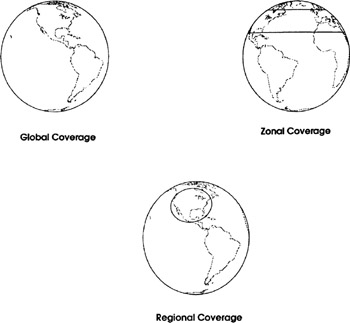 Figure 15.1: Types of Earth coverage.
 The required frequency and duration of coverage is also important. Communication and navigation systems usually must be available 24 h/day. Other functions may require coverage of the area of interest for only part of the day (e.g., 8 h/day). Still others, such as weather, resources, or surveillance satellites, may require only occasional views of the area of interest. A resources satellite, for instance, may require only weekly viewing of points...

 TABLE OF CONTENTS