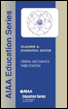
Orbital Mechanics, Third Edition

The solar system consists of a single star (the sun) and nine principal planets that move around the sun in orbital paths that are nearly circular except for that of Pluto, which is highly eccentric. Early man considered the Earth to be the center of the universe and the five planets, Venus, Mercury, Mars, Jupiter, and Saturn, to be divine. The most ancient observations of the planets date back 2000 years B.C. and appear to come from the Babylonian and Minoan civilizations. The term planet means "wanderer" in Greek and refers to the celestial objects that move relative to the stars.
The Egyptians, Greeks, and Chinese once thought of Venus, for example, as two stars because it was visible first in the morning and then in the evening sky. The Babylonians called Venus "Istar," the personification of woman and the mother of the gods. In Egypt, the evening star was known as Quaiti and the morning star Tioumoutiri; to the Chinese, Venus was known as Tai-pe, or the Beautiful White One. The Greeks called the morning star Phosphorus and the evening star Hesperos but, by 500 B.C., the Greek philosopher Pythagoras had come to realize that the two were identical. As time passed, the Romans changed the name of the planet to honor their own goddess of love, Venus.
It was not until the Golden Age of Greece that astronomy as a science was placed on a firm foundation and the Earth and the planets were regarded...