Process Heat Transfer: Principles and Applications

The transport of energy in chemical plants and petroleum refineries is accomplished by means of heat-exchanger networks (HENs). Hence, the design of such networks is an important aspect of chemical process design. Each individual heat exchanger in the network can be designed by the methods discussed in previous chapters. But before this can be done, the overall configuration of the HEN must be determined. Decisions must be made as to how the process streams will be paired for heat exchange and the extent of the heat exchange between each pair.
The Pinch Design method provides a systematic approach for configuring HENs based on fundamental thermodynamic principles and simple heuristic rules. This chapter provides an introduction to the Pinch Design method.
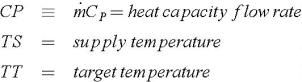
Test Case Number 3, or TC3 for short, is a simple HEN problem devised by Linnhoff and Hind-marsh [1] to illustrate the concepts involved in the Pinch Design method. The problem has four process streams as shown in Table 8.1. The nomenclature used in this table is as follows:
| Stream | Type | TS ( C) | TT ( C) | CP (kW/ C) | Duty (kW) |
|---|---|---|---|---|---|
| 1 | Hot | 150 | 60 | 2.0 | 180 |
| 2 | Hot | 90 | 60 | 8.0 | 240 |
| 3 | Cold | 20 | 125 | 2.5 | 262.5 |
| 4 | Cold | 25 | 100 | 3.0 | 225 |
In addition to the four process streams, there is a single hot utility available at a temperature above 150 C and a single cold utility available at a temperature below 20 C. The minimum approach, ? T